Off-site GEO for agencies means tracking which third-party pages, meaning Reddit threads, G2 listings, YouTube reviews and editorial posts, AI engines cite about each client, then reporting it through one identical record format across every account. The portable structure is the point: same query schema, same four metrics, same cadence, so numbers are comparable client to client and become a benchmark no single client owns.
Agencies are getting asked the AI question in every renewal meeting now, usually phrased as "why does ChatGPT recommend our competitor?" The honest answer is almost always that AI is quoting pages the agency doesn't own and doesn't currently track. This post covers how to build off-site GEO into a retainer: the record format that ports across clients, what to sell, what to price, what to refuse to promise, and the compounding asset most agencies miss. Every figure below is cited inline, and where a number is a vendor's own estimate rather than a published study, it says so.
Why off-site GEO is an agency service, not a client task
Because the work is repetitive, low-glamour, and identical in structure across accounts, which is the definition of something an agency should own. Tracking which off-site pages an AI quotes means running a fixed query set on five engines on a schedule and logging the results the same way every time. In-house teams do that badly because it's nobody's job. Agencies do it well because it's the same job twenty times over.
The demand exists because the visibility gap is real and clients can feel it. Only 38% of the pages cited in Google's AI Overviews also rank in its top 10, down from 76% eight months earlier, though Ahrefs credits part of that fall to better parsing rather than to Google alone, so roughly 62% of cited pages sit outside the rankings agencies already report on. Reddit alone is referenced in about 40% of AI answers. That means a client can hold page one, watch their rank report stay green, and still lose the AI answer to a two-year-old forum thread. Explaining that gap is the pitch, and the long version is in what off-site GEO is and why your AEO tool can't see it.
The portable citation spine: one schema across every client
The original move here is treating the citation log as a shared schema rather than a per-client deliverable. Build one record format, use it unmodified on every account, and your reporting stops being twenty bespoke spreadsheets and starts being one dataset with a client column. That single decision is what makes agency GEO scale, and it's what makes the cross-client benchmark below possible at all.
The spine has three fixed parts.
| Part | Fixed across clients | Varies per client |
|---|---|---|
| Query set | 25 to 50 buyer questions, same six question shapes: best-for, alternative-to, pricing, integration, is-X-good, how-do-I | The nouns, meaning client name, category and competitor set |
| Record fields | Query, engine, cited URL, source type, owner, quoted claim, date checked | Nothing |
| Cadence | Same check day, same five engines, fixed for a full quarter | Reporting frequency by contract tier |
Keep the question shapes identical and only swap the nouns. A "best [category] for [use case]" query behaves the same way for a payroll SaaS and a project-management tool, so results stay structurally comparable. The moment an account manager invents a bespoke query template, that client drops out of your benchmark permanently. The underlying record format, and why the quoted claim field matters more than it looks, is covered in how to report off-site AI citations to stakeholders.
The four metrics to report per client
Report citation count per engine, off-site share, AI Share of Voice, and net change. Four numbers, derived from the same log, on every client report without exception. Consistency is worth more than completeness here: a client who sees the same four metrics for six months can read the trend themselves, which is when GEO stops being an experiment and becomes a renewal line.
Citation count, split by engine. Never blend engines, because the denominators are wildly different: ChatGPT cites a mean of 6.88 sources per answer, Google AI Overviews 12.06, and Perplexity 16.35. Three Perplexity citations are a much smaller achievement than three ChatGPT citations, and a blended figure hides that from the client and from you.
Off-site share. What percentage of citations sit on third-party pages versus the client's own domain. This is the number that justifies your retainer existing, because it shows the client, in their own data, how much of their AI presence they don't control.
AI Share of Voice. Of all brands cited on the client's tracked queries, what share is theirs. Published bands put a category leader at 25 to 45%, challengers at 8 to 20% and new entrants under 5%, but read the small print before you put them on a slide: those are share of citation on a brand's single strongest engine, not blended across five. A number averaged over five engines will land below the band, and a client who compares the two without being told will think they are losing. 30% or parity with the nearest peer is a fair first target and is stated as a target rather than an observed distribution. Method detail lives in AI Share of Voice, off-site.
Net change, with losses named. Citations gained minus citations lost, and the lost ones listed by URL. Agencies are tempted to report only gains. Don't: naming a loss before the client finds it is the single cheapest trust purchase in the relationship, and it is the opening for the remediation work that follows.
What the deliverable actually looks like
Three tiers, escalating: the receipt, the roll-up, and the roadmap. Most agencies try to sell the roadmap first and can't support it, because a roadmap without a log underneath is just opinion. Build the tiers in order and each one funds the next.
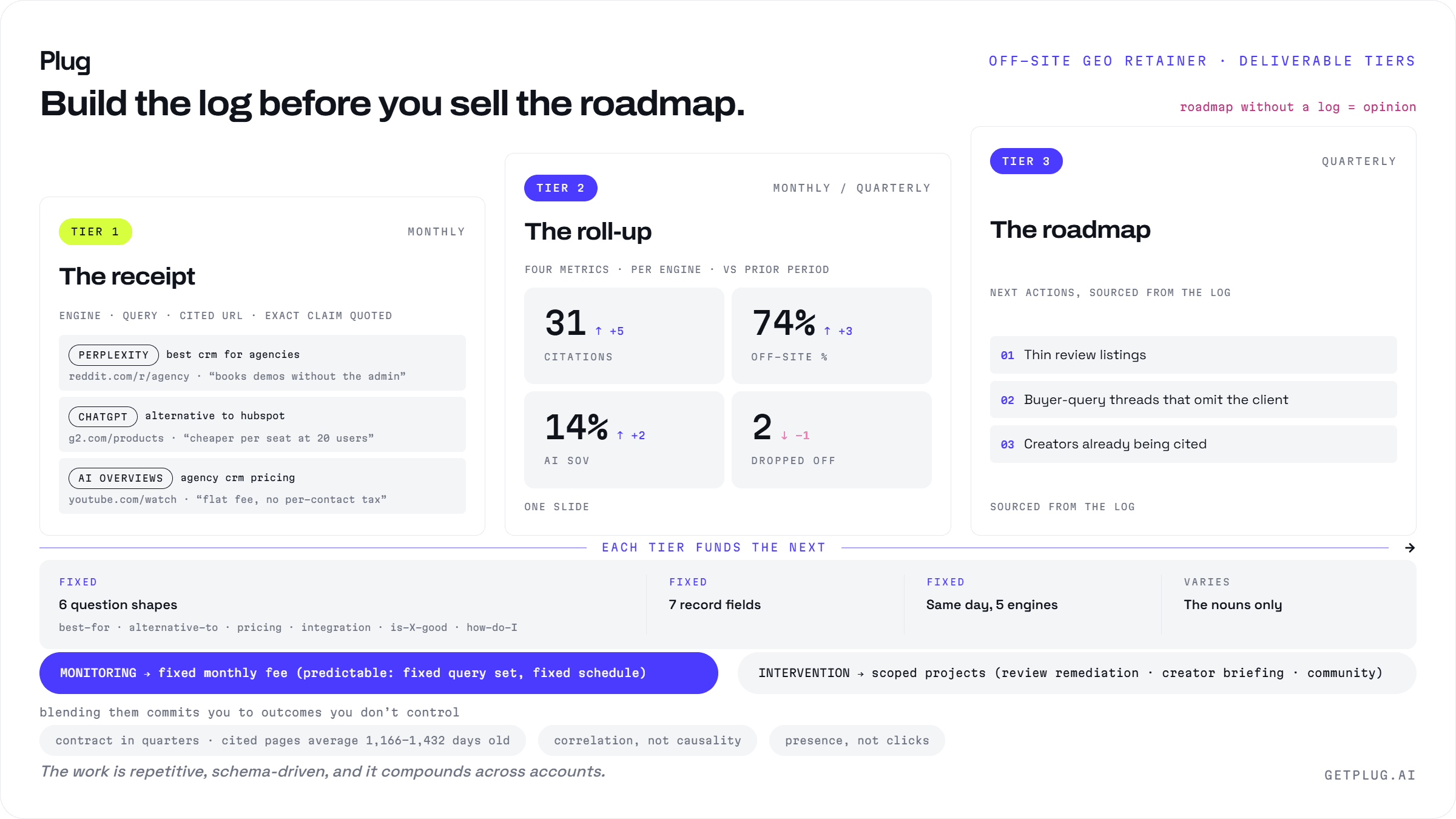
- Tier 1, the receipt, monthly. The raw citation log for the period, filtered to that client, plus three named receipts: engine, query, cited URL, and the exact claim quoted. This is the evidence layer. It takes an afternoon and it is the thing clients screenshot for their own boards.
- Tier 2, the roll-up, monthly or quarterly. The four metrics with trend arrows, per engine, against the previous period. One slide. This is what the client's exec sees, and it's where the agency's consistency shows up as competence.
- Tier 3, the roadmap, quarterly. What to do next, sourced from the log itself: which review listings are thin, which Reddit threads rank for buyer queries but omit the client, which creators already get cited and should be briefed. Review platforms are usually the fastest tier-3 win, since Leapd puts domains with active G2 or Capterra profiles at roughly 3x higher citation probability, a vendor estimate with no published sample behind it, and most clients' listings are neglected either way. See how AI reads your G2 and Capterra listings and briefing creators for citations, not impressions.
Scoping and pricing an off-site GEO retainer
Price the monitoring as a fixed monthly fee and the intervention work as project scope on top. The tracking cost is predictable, because it's a fixed query set on a fixed schedule, while earning new citations is variable, slow, and depends on the client's willingness to be visible. Blending the two into one number is how agencies end up owing outcomes they can't control.
A workable shape: a monitoring tier covering 25 to 50 queries across five engines with the monthly roll-up, then separately scoped work for review-platform remediation, creator briefing programs, and community participation. Sell the monitoring first even to clients not ready for the rest. It costs little to run, produces a monthly artifact nobody else is sending them, and generates the evidence that sells the intervention work three months later. Add the client-comparable framing to your pitch: "we track this identically across our book, so your 14% Share of Voice has context."
The honest limits to write into the contract
Do not promise timelines, causality, or clicks. Every agency that has been burned on AI visibility was burned on one of those three, and all three are avoidable by saying so in writing before the first invoice.
Timing. The pages AI cites are old on average. Perplexity's in-text citations run to 1,166 days, against a 1,064-day mean across assistants and 1,432 days for organic results, measured over 16.975M cited URLs. Read that carefully before you repeat it to a client, because it is often repeated backwards: Ahrefs' actual finding is that AI cites fresher pages than organic search does, not staler ones. What it means for you is that the corpus is dominated by long-established pages, so anything new competes against years of accumulated material. It does not tell you how long a new page waits to become eligible, because that study does not measure it. Contract in quarters because you cannot schedule someone else's forum thread, not because a number set the clock.
Causality. You can show that a citation appeared after a campaign; you generally cannot prove the campaign caused it. Log actions and citations separately and let the pattern accumulate.
Clicks. An AI citation frequently produces no visit at all, so report it as brand presence and never convert citation counts into a traffic forecast. Also police the vocabulary in your own reports: a citation, a mention, and a brand mention are different events, and conflating them inflates the numbers you'll be held to next quarter. See citation vs mention vs brand mention.
One craft note that pays off in the tier-3 work: when you do produce or brief content, put the answer in the first third of the page. 44.2% of ChatGPT citations are lifted from the first 30% of a document, which is a formatting instruction, not a strategy.
The asset most agencies miss: the cross-client benchmark
Because the spine is identical across accounts, your log stops being twenty client reports and becomes one dataset, and that dataset answers questions no individual client can answer alone. Which engines cite review sites most in fintech. What Share of Voice a category challenger typically holds. How long a seeded Reddit thread takes to surface, measured across fifteen brands instead of one.
That is the compounding asset. Client work funds it, and the benchmark wins the next pitch, because "here's what normal looks like in your category" is a claim no in-house team and no single-account competitor can make. Two rules protect it: aggregate and anonymise before anything leaves the building, and never let an account team fork the query schema for convenience. A forked schema is a client permanently outside the benchmark, and the loss is invisible until you go to run the numbers.
Where this leaves you
Off-site GEO is the rare new service line that fits an agency better than it fits the client. It's repetitive, schema-driven, and it compounds across accounts, which is the exact profile of work agencies are built for. Start with the monitoring tier on your three most AI-curious clients, run the same spine on all three, and by the end of the quarter you'll have something none of them could have built alone: a report with context.