AI Share of Voice is the percentage of AI answers in your category that name or cite your brand. On-site tools measure only the slice where an engine credits your own domain. But 62% of the pages cited in Google's AI Overviews don't rank in its top 10, so a large part of your real share of voice is decided off-site, on Reddit, review sites and creator posts your dashboard cannot see.
Most teams now track some version of AI Share of Voice. Almost none track the version that matters. If your tool only checks whether ChatGPT and Perplexity credit your own domain, it is measuring a sliver and calling it the whole. This guide defines AI Share of Voice properly, shows why the off-site half is the bigger number, gives you benchmarks to aim for, and lays out how to measure the part your dashboard misses.
What is AI Share of Voice?
AI Share of Voice is the percentage of AI-generated answers for your category's queries where your brand is cited or named. You pick a set of buyer queries, run them across engines like ChatGPT, Perplexity, Google AI Overviews and Copilot, and count the answers that mention you against the total. It is the AI-search version of the old market-share metric, rebuilt around citations instead of ad spend.
The formula is simple. Take a fixed list of category queries, run each one across each engine on a schedule, and divide the answers that cite or name your brand by the total answers checked. If 100 answers name you out of 400 checked, your AI Share of Voice is 25%. The discipline is in the inputs: the same query list, the same engines, the same cadence, counted once per answer, per engine, per day. Change the query set and the number stops being comparable.
One caution before the benchmarks. A name-drop and a citation are not the same measurement, and engines hand out the first far more freely than the second. Share of voice built on citations you can trace back to a specific post is worth more than share of voice built on raw mentions, for the reasons set out in citation vs mention vs brand mention.
On-site vs off-site AI Share of Voice
Your AI Share of Voice splits in two: the answers that cite your own domain, and the answers that cite content about you somewhere else. On-site tools see the first and miss the second. Since most of what AI quotes is third-party content, the off-site half is usually the larger, and the one that actually moves your total.
Here is the mechanism. AI search is retrieval-based: the engine pulls live documents, ranks them, and quotes the survivors, and it weights independent third-party sources more heavily than your marketing copy because they read as validation. That is why only 38% of the pages cited in Google's AI Overviews also rank in its top 10, a figure that was 76% eight months earlier. The other 62% sit on page two or beyond, or nowhere in the rankings at all. Reddit alone is the most-cited domain in AI answers, ahead of Wikipedia and YouTube.
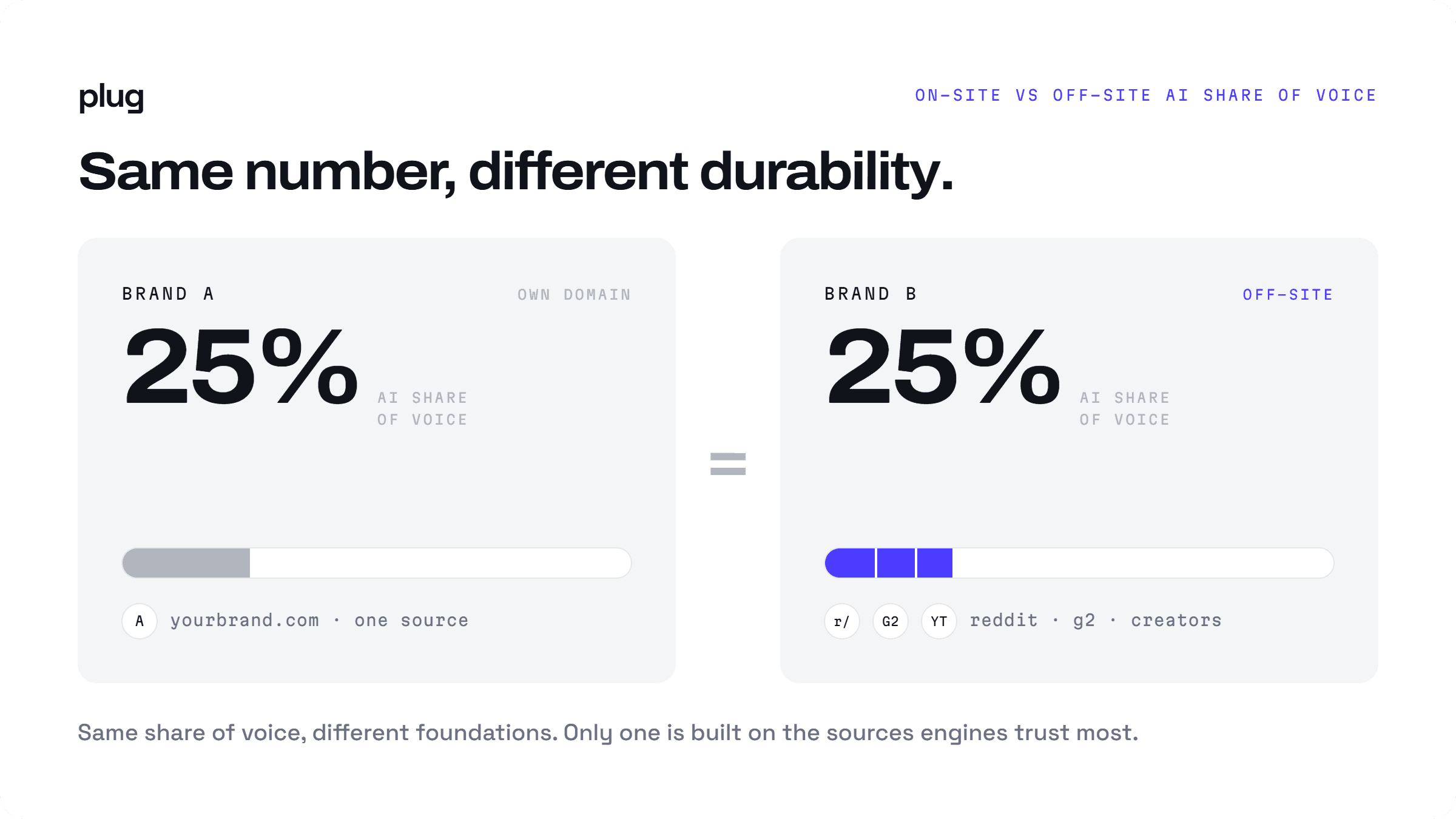
So picture two brands with the same total AI Share of Voice of 25%. Brand A earns it from its own docs and blog. Brand B earns it from Reddit threads, a G2 listing and three creator videos. Brand B is far more durable, because it is winning on exactly the sources engines trust most, and an on-site dashboard would show Brand B a near-empty screen. The single number hides which half you own. That is the gap this whole category exists to close, covered in full in what off-site GEO is.
What is a good AI Share of Voice?
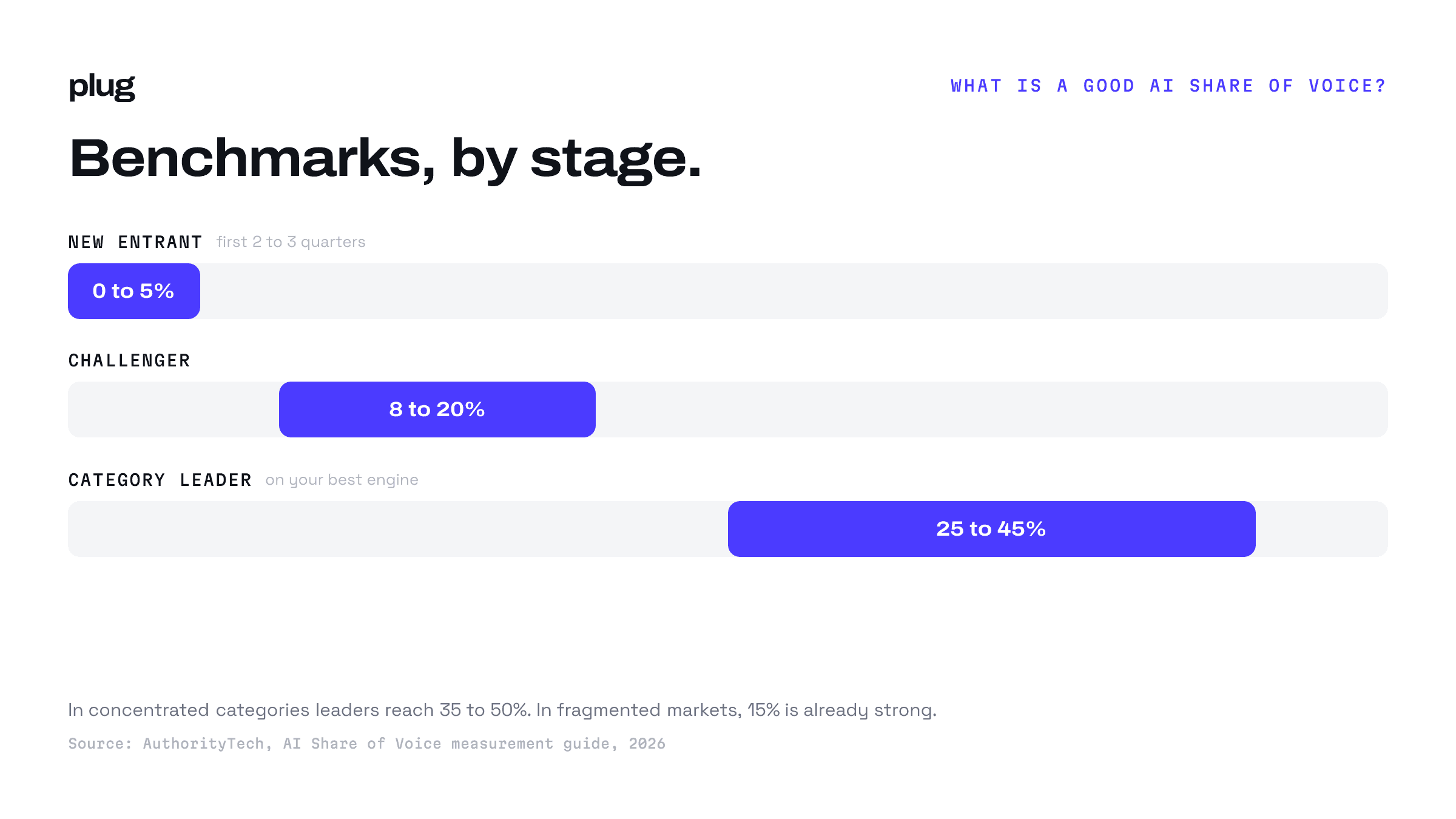
There is no single number, because the right target depends on how crowded your category is and how long you have been at it. The most useful published framing splits it by stage rather than by a flat benchmark.
| Stage | AI Share of Voice |
|---|---|
| New entrant, first two to three quarters | under 5% |
| Challenger | 8 to 20% |
| Category leader, on your best engine | 25 to 45% |
Two adjustments sit on top of that. In concentrated categories, market leaders typically reach 35 to 50%, while in fragmented markets 15% or above already represents strong positioning. And as a first target rather than an end state, 30%, or parity with the leading platform in your category, is a reasonable place to aim, with the same source making the point that relative momentum matters more than the absolute score: a brand moving from 8% to 14% in two months is doing better than one sitting still at 22% while its competitors climb.
Measure per engine, not just in aggregate. A 25% average can hide a strong Perplexity showing and near-zero on AI Overviews, and those two facts call for completely different work.
How to measure off-site AI Share of Voice
To measure the off-site half, you run your category queries across each engine on a schedule, capture every citation, and sort them into "our domain" against "content about us elsewhere". The off-site share is the second bucket as a percentage of all answers checked. Do it continuously, because AI answers are not stable and today's citation can vanish tomorrow.
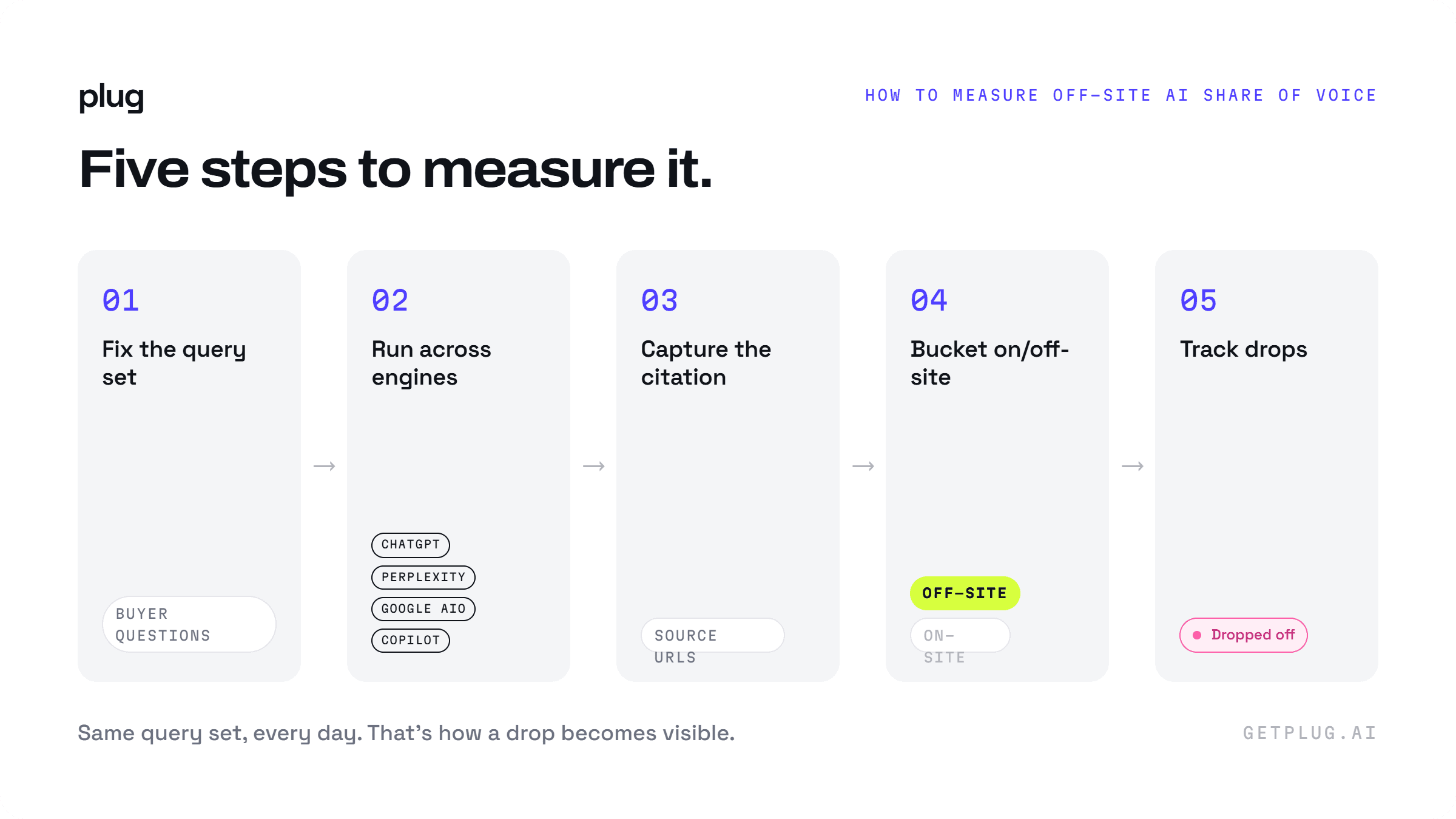
A workable method in five steps:
- Fix your query set. Ten to thirty buyer queries: the "best X for Y", "X alternatives" and "is X any good" phrasings real buyers type. Keep the list frozen so the number stays comparable over time.
- Run every query across every engine on a cadence. ChatGPT, Perplexity, Google AI Overviews and AI Mode, and Copilot, checked daily or weekly. Each engine-day is its own data point.
- Capture the citation, not just the mention. Record the actual source URL the engine credited, so you can tell a Reddit thread from your own docs from a review listing.
- Bucket on-site against off-site. Split citations into your domain and everything else, then attribute each off-site citation to a specific post and the creator who made it.
- Track drops as events. A source cited this week and gone next week is a change worth logging. Continuous checking is the only way to catch a citation disappearing, rather than mistaking silence for stability.
This is deliberate work, and it is the reason on-site AEO tools skip it. Watching one domain is easy. Watching the open web is not.
Why your dashboard misses most of it
Most AI-visibility dashboards were built to answer "does AI cite my website?", so they crawl and monitor your domain and stop there. That design blinds them to Reddit threads, G2 and Capterra listings, YouTube reviews and creator posts, which is precisely where a large share of your citations are earned. The tool isn't broken. It is pointed at the wrong half of the web.
The evidence is one-sided. When 62% of cited pages sit outside Google's top 10 and Reddit alone is the most-cited domain in AI answers, a tool that only reads your own site is reporting on a minority of the answers that decide your visibility. It will show a clean, quiet dashboard while your actual share of voice is being won or lost on forums and review sites it never loads. That is the half your GEO tool can't see, and it is why the off-site view has to be measured on purpose. See where AI actually gets its answers for the full source breakdown.
How to grow off-site AI Share of Voice
You grow off-site AI Share of Voice by earning citations on the third-party sources engines already trust, then giving those sources the extractable format AI quotes. That means credible Reddit participation, current review-site listings, and creator content, each written with a direct answer up top, hard numbers, and clean entity naming so an engine can lift it cleanly.
Format is leverage, and there is research behind that. In GEO: Generative Engine Optimization, presented at KDD 2024 by researchers from Princeton and IIT Delhi, adding quotations, statistics and explicit sourcing lifted a page's visibility in generative answers by up to 40% across 10,000 queries, while keyword stuffing did not help. Pair that with a short, direct answer near the top of the page, which is standard practice in GEO guidance rather than a proven law, and you make the off-site content about you far easier to quote. The tactic-by-tactic version lives in where AI actually gets its answers. Grow the sources engines cite, and your off-site share of voice, and your total, follows.
Where this leaves you
AI Share of Voice is only honest when it counts both halves. The on-site number is easy and comforting and mostly beside the point, because the answers that shape buyer decisions are built from Reddit, reviews and creator content your domain-watching tool never sees. Measure the off-site half deliberately: a fixed query set, every engine, a real cadence, each citation attributed to a post and a person. Aim for double digits on your core queries, treat the 25 to 45% band as leader territory, and remember the number moves off-site or it doesn't move at all.