AI engines cite G2, Capterra and other review sites heavily. Review platforms appear in about 34.5% of Google AI Overviews, and just five of them, Gartner Peer Insights, G2, Capterra, Software Advice and TrustRadius, account for 88% of all review-platform citations. AI reads your listing as independent validation, so a strong profile can get your product named in an answer even when your own site isn't.
Review sites are the off-site surface most teams still treat as a 2019 problem: set up the profile, chase a few reviews, forget it. But the buyer who used to read those pages now reads an AI answer that quoted them. The click may be gone. The citation isn't. This post covers how often AI cites review sites, which ones win, why they get quoted when your own domain doesn't, and how to make your listing the one a model reaches for.
Do AI engines actually cite G2 and Capterra?
Yes, and more than most teams assume. In SE Ranking's analysis of 22,729 AI Overview responses drawn from 30,000 commercial keywords, 34.5% of AI Overviews cited at least one review platform, roughly one in three answers about products or software. When a review platform appears it rarely appears alone: the average is 2.28 review-platform links per response, because Google likes to compare perspectives across sources.
Worth scoping that study before leaning on it: it is a one-time snapshot of US AI Overviews taken on 1 December 2025, not a longitudinal series. The direction is well supported. The decimal places are a single reading.
The tilt is structural rather than a quirk of Google. Retrieval-based engines weight third-party sources as validation, because what other buyers concluded reads as more trustworthy than your own marketing claim. That is why domains with active G2 or Capterra profiles show roughly three times higher AI citation probability.
The pattern is not Google-only, though the public per-engine data is thin. AirOps' work on review-site citations covers ChatGPT, Gemini and Perplexity as one group rather than separately, so anyone telling you precisely how each engine treats a G2 listing is extrapolating. For the full cross-engine picture of what gets quoted, where AI actually gets its answers lays out the source mix.
Which review sites AI cites most, and the February shake-up
A small club dominates. Across AI Overviews, five platforms account for 88% of all review-platform citations: Gartner Peer Insights at 26.0%, G2 at 23.1%, Capterra at 17.8%, Software Advice at 12.8% and TrustRadius at 8.3%. Below the top five, visibility falls off a cliff. GetApp and Clutch sit at 2.51% and 2.38%, and most others are under 1%.
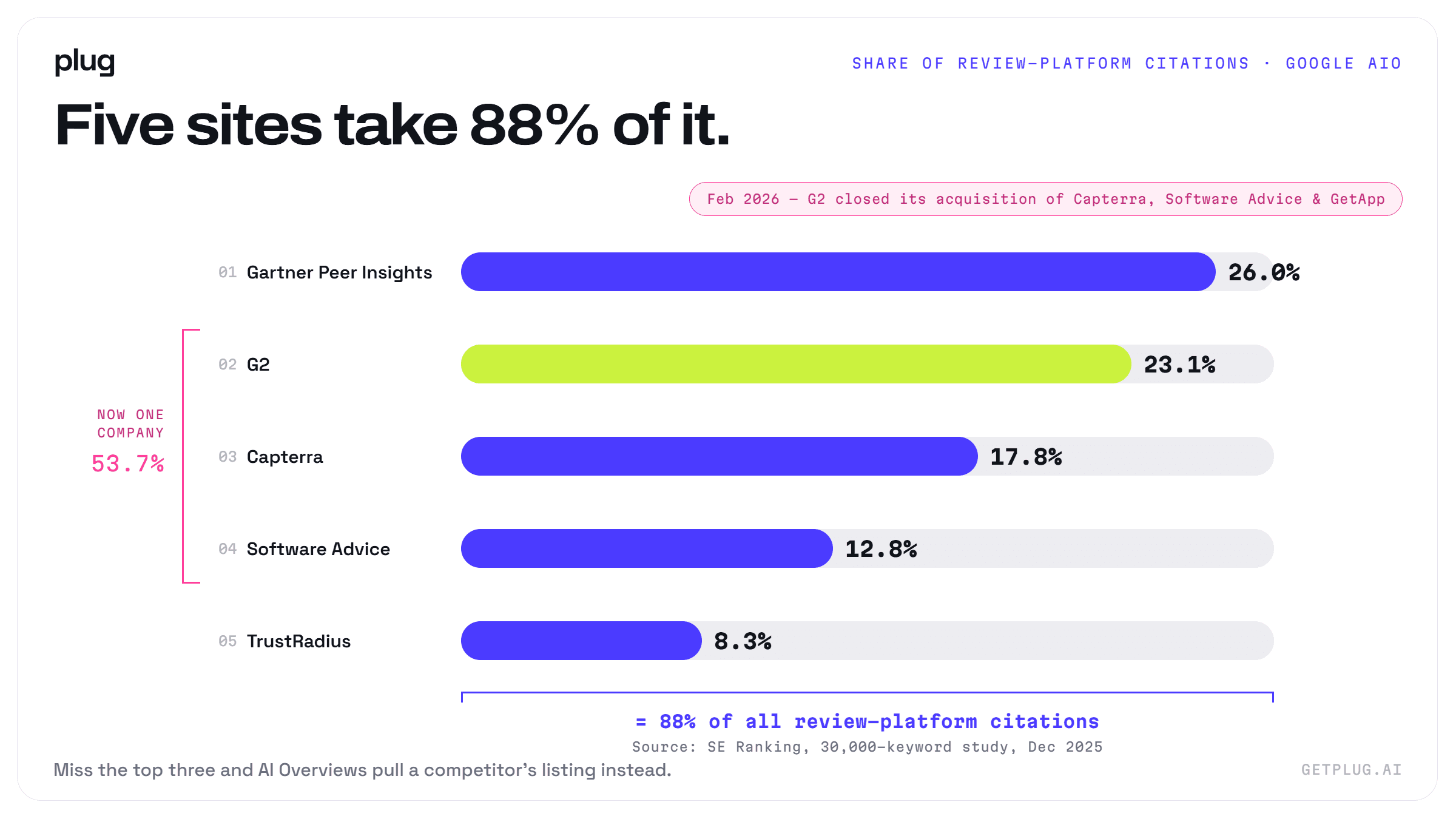
Then the map redrew itself. G2 announced on 29 January 2026 that it would acquire Capterra, Software Advice and GetApp from Gartner, and the deal closed a week later on 5 February, for roughly $110 million according to Gartner's 10-K. Line that up against the citation share and the implication is blunt: G2, Capterra and Software Advice together are 53.7% of review-platform citations, and they now sit under one company. If your category's AI answers lean on that cluster, and for B2B software they usually do, your presence there is no longer optional.
Two more details shape how to read a citation. Review platforms are only 8.5% of all links in AI Overviews, yet three of the five most-cited domains overall are review sites, sitting behind YouTube and Reddit. And query wording swings everything: explicit review or rating searches pull a review platform into 49% of AI Overviews, while "best" and "top" list queries do so 17.1% of the time, about three times less. For "best of" prompts, AI reaches for ranking blogs and media instead.
Why review listings get cited when your own site isn't
Because an AI engine reads independence as authority, and your listing is independence you can influence but don't own. A G2 page carries structured third-party signals, star ratings, verified reviews, pricing, feature grids, pros and cons, that a model can lift cleanly and attribute to someone other than you. Your homepage saying "the number one CRM for teams" is a claim. Four hundred reviews on Capterra saying something similar is evidence. Retrieval engines quote evidence.
The scale of the off-site skew makes this urgent. Only 38% of the pages cited in Google's AI Overviews also rank in its top 10, down from 76% eight months earlier, so roughly 62% of cited pages sit outside the rankings most teams watch, and review listings are a large slice of that. Format helps too. The review page's tidy comparison layout is exactly the shape AI likes, which is partly why listicles make up 21.9% of AI citations and articles 16.7%, the two most-cited formats. Your listing is, functionally, a listicle entry about you that a trusted third party publishes.
The paradox: traffic collapsed, citations didn't
Here is the part that changes what you do about it. The humans stopped visiting review sites. The machines didn't stop reading them.
Between early 2024 and the end of 2025, organic traffic to the top platforms cratered: G2 fell 84.5%, Capterra 89% and TrustRadius 92.2%, even as those same platforms stayed among the most-cited sources in AI Overviews. The value didn't disappear. It changed form, from a click you can see in analytics to a citation you can't.
That is the trap. If you judge your review listings by referral traffic they look dead, so you deprioritise them at exactly the moment they become an AI-visibility asset. The influence moved upstream: your Capterra page now shapes the answer a buyer reads before they consider clicking anything. A dropped review, a stale feature list or a thin profile no longer costs you a visit. It costs you a sentence in the answer, and possibly the recommendation. Measuring that means watching citations rather than sessions, which is the premise behind AI Share of Voice, off-site.
How to optimise your review listings for AI citation
Treat the listing like a page you are trying to get quoted, because that is what it is. Five moves, in order of leverage.
- Exist on the right platforms. Claim and complete profiles on Gartner Peer Insights, G2 and Capterra at minimum, the three that keep landing in the top five most-cited domains. An empty or unclaimed listing means AI pulls a competitor's instead.
- Fill every structured field. Pricing, features, integrations, categories, pros and cons. These are the machine-readable blocks AI lifts. A listing with a paragraph and a logo gives a model nothing to quote.
- Keep review volume and recency up. Ask happy customers on a schedule. Fresh, specific reviews give the engine current, quotable language, and concrete detail is what lifts citation odds. In the Princeton and IIT Delhi GEO study at KDD 2024, adding statistics lifted a page's visibility in generative answers by 32.8%, and citing sources by 27.7%.
- Win the specific queries, not just "best". Explicit review and rating queries trigger review-platform citations about three times more often than "best" and "top" ones, so make sure your listing is strong for "[your category] reviews" and "[your product] pricing".
- Audit what AI reads, not just what it shows. Run your buyer queries in ChatGPT, Perplexity and Google AI Overviews, note which review pages get cited about your category, and check whether the quoted detail is accurate. Then fix the listing feeding the wrong line. For how the biggest engine assembles these answers, see how Google AI Overviews and AI Mode pick sources.
Why your AEO dashboard can't see review-site citations
Because your AEO tool watches your domain, and a review-site citation is by definition not on your domain. It can tell you Google indexed your pricing page. It cannot tell you an AI Overview answered "best CRM for small teams" by quoting your Capterra rating alongside a competitor's G2 pros and cons, a decision made entirely on pages you don't control and your dashboard never scans.
That blind spot is the reason off-site tracking exists. If review platforms sit in a third of AI Overviews, and 62% of cited pages fall outside the top 10, then a meaningful share of the answers shaping your brand's reputation are built from listings your analytics can't see. To measure it, run your buyer queries across the engines on a schedule, log every cited URL, and separate your domain from the third-party pages doing the real work. That is the gap explored in what off-site GEO is and why your AEO tool can't see it.
Where this leaves you
Review sites didn't fade out when their traffic collapsed. They migrated into the AI answer, where a third of product questions now quote them and five platforms own nearly nine in ten of those quotes. Your G2 and Capterra listings became AI-visibility infrastructure the moment buyers started reading answers instead of pages.
So the move is twofold: make those listings complete, current and quotable enough to be the source AI reaches for, and measure them by citation rather than by click, because the click already left.