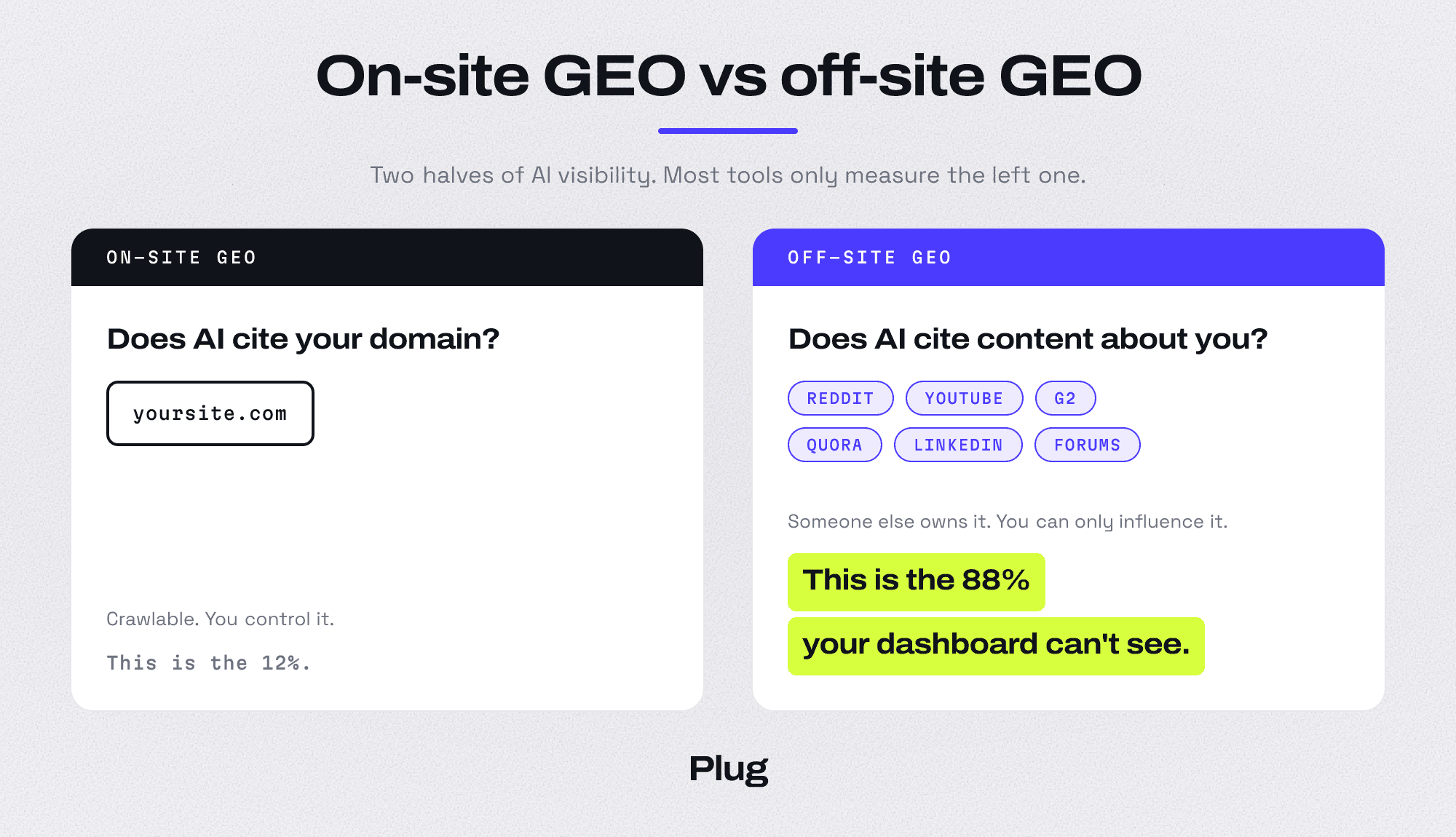
Off-site GEO is the practice of tracking and optimising whether AI search engines cite content about you that lives on platforms you don't own: Reddit threads, YouTube reviews, forum answers and directory listings. On-site GEO asks “does AI quote my domain?” Off-site GEO asks “does AI quote everything else?” It matters because most of what AI actually cites isn't on your website at all.
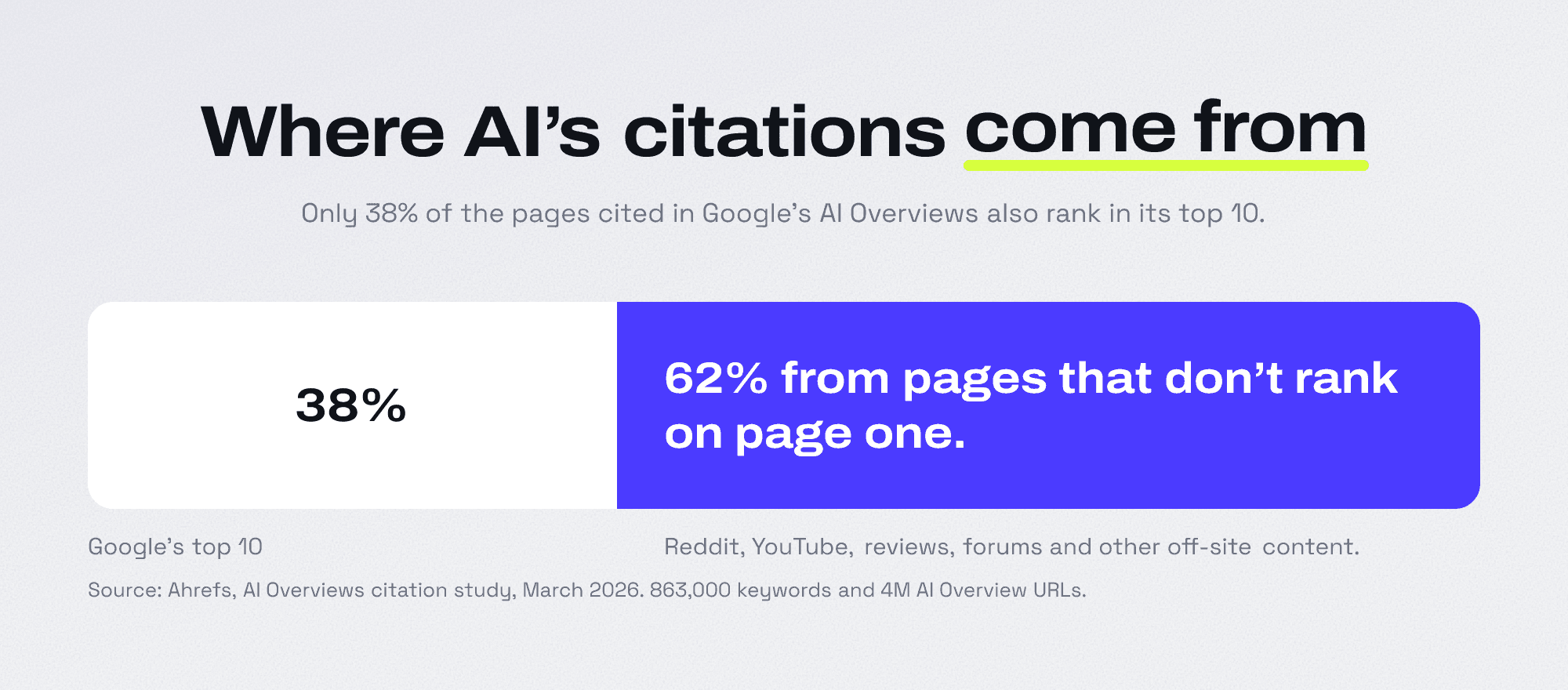
That last line isn't a slogan. Only 38% of the pages cited in Google's AI Overviews also rank in its top 10, and that figure was 76% eight months earlier. The other 62% sit on page two or beyond, or nowhere in the rankings at all. If your entire measurement setup points at your own domain, you are watching the smaller half of the picture, and the half that is shrinking.
This guide defines off-site GEO, explains how it differs from the AEO and GEO tools you already use, and shows why the gap exists in the first place.
What does off-site GEO actually mean?
Off-site GEO (generative engine optimisation) is the discipline of getting AI engines to cite third-party content about your brand, and measuring when they do. The content sits on Reddit, YouTube, G2, Quora, LinkedIn and review sites: places you can influence but don't control.
Generative engine optimisation is the broader practice of structuring your online presence so answer engines like ChatGPT, Perplexity and Google AI Overviews cite you. Most GEO work has quietly assumed “you” means “your website.” Off-site GEO drops that assumption. It treats the content about you, wherever it lives, as the thing to measure, because that is what the engines are reading.
Why AI leans on content you don't own
AI search is retrieval-based, not memory-based: the model pulls live documents, ranks them, and quotes the ones it trusts most, and it trusts independent sources more than your marketing copy. A genuine Reddit recommendation reads as validation in a way your own landing page never can.
When someone asks ChatGPT “best CRM for consultants,” the model doesn't recite your homepage. It retrieves documents, weighs them, and synthesises an answer from the ones that look most credible. Those documents are overwhelmingly third-party: editorial reviews, forum threads, video transcripts and Q&A pages. The numbers bear it out. Reddit is the single most-cited domain across the major engines, with Wikipedia and YouTube close behind, and on Tinuiti's January 2026 numbers Reddit accounts for 44% of the social-media citations in Google AI Overviews.
There's a second reason, and it's the one most teams underrate. Branded mentions predict AI citations far better than backlinks do, a correlation of 0.656 to 0.709 against 0.218. The web's chatter about you, not just the links to you, is what decides whether an engine names you.
On-site GEO vs off-site GEO
On-site GEO measures whether AI cites your own domain and is something you can crawl and fix directly. Off-site GEO measures whether AI cites content about you on platforms you don't own, which no crawl-your-site tool can see. They answer different questions and are complementary, not competing.
| On-site GEO / AEO tools | Off-site GEO | |
|---|---|---|
| Question answered | Does AI cite my domain? | Does AI cite content about me elsewhere? |
| Where the content lives | Your website | Reddit, YouTube, G2, Quora, forums, LinkedIn |
| How it's measured | Crawl and audit your pages | Track named placements across engines |
| Who owns it | You | Someone else (creator, customer, community) |
| What you can do | Rewrite the page | Influence, brief creators, seed, report |
| Blind spot | Everything off your domain | (This is the half that was invisible) |
The tools most teams already run, the ones that audit your own pages for AI visibility, do their job well. Off-site GEO isn't a replacement for them. It's the other half of the same picture.
Why the gap exists
The gap exists because GEO grew out of SEO, and SEO was always organised around a property you control. Crawl the site, audit the pages, fix the structure. Off-site content breaks that model on the first step: there is no single site to crawl, because the content is spread across a dozen platforms and none of them are yours.
So when an engine builds an answer about your product from a Reddit thread and a review listing, your dashboard shows nothing. Not a low number. Nothing. The work is invisible rather than underperforming, which is a much harder problem to raise in a planning meeting. You cannot defend, improve, or even take credit for work you can't see.
How to know if a citation is real
A citation is an engine quoting a specific piece of content when it answers a query. A mention is just the engine saying your name; a link is neither. Only a citation proves a specific post did work, and off-site GEO counts citations once per answer, per engine, per day, so the number survives scrutiny.
This matters because answers aren't stable. The same query can return different sources tomorrow. A naive counter inflates fast; a citation that vanishes should register as a drop, not as silence. Measuring properly is most of the work, which is exactly why the off-site half has gone untracked for so long.
Where off-site GEO fits in your stack
Off-site GEO sits alongside your on-site AEO tool and your social listening, not on top of them. Social listening tracks mentions; on-site tools track your domain; off-site GEO tracks AI citations of content you don't own. Run all three and the picture is finally complete.
For most teams the practical starting point is small: list the off-site posts, threads and listings that already mention you (most teams find placements they didn't know existed), add the buyer queries you already report on, and watch which posts get quoted, on which engine, and whether it's climbing or slipping. From there it becomes a programme: briefing creators for citations rather than impressions, and leaning into the Reddit and review content you don't own.