A citation is when an AI engine quotes or credits a specific piece of content in its answer. A mention is when the engine says your brand name without crediting a source. A brand mention is your name appearing anywhere across the web, cited or not. All three matter, but only a citation proves a specific post did the work, which is why it is the number that holds up in a report.
These words get used interchangeably, and it costs teams real clarity. If you report “mentions” when you mean “citations,” you inflate the number and can't tie it to anything you did. This guide defines all three, shows what each one actually proves, and explains why the distinction decides whether your AI visibility reporting means anything.
What is an AI citation?
An AI citation is when an engine quotes, names or links a specific source while answering a query. It is the strongest signal because it ties a specific piece of content to a specific answer: this post, on this engine, for this question, on this date.
A citation is evidence. When Perplexity answers “best CRM for consultants” and credits a Reddit thread, that thread earned the citation, and you can point to it. This is why citations are the unit that survives scrutiny in a stakeholder report, and why counting them properly, once per answer, per engine, per day, is most of the work.
What is a mention?
A mention is when an AI engine names your brand in its answer without crediting a source. Your name is in the text, but nothing tells you why the engine said it or which content earned the reference. It is a signal that you exist in the model's answer, not proof that a specific post worked.
Mentions are worth watching, because being named at all is better than being absent. But they are hard to act on. If ChatGPT calls your product “a popular option” with no source, you cannot tell whether it came from a Reddit thread, a review listing, or the model's training data. You know you appeared. You do not know what to do more of.
What is a brand mention?
A brand mention is any instance of your brand name appearing across the web, on a blog, a forum, a news site or a social post, whether or not an AI engine ever quotes it. It is an off-page signal that feeds AI visibility indirectly, rather than a measurement of an AI answer itself.
Brand mentions matter more than most teams think. Branded web mentions correlate with AI citations at 0.656 to 0.709 depending on the engine, versus 0.218 for backlinks, so the volume of chatter about you is one of the strongest predictors of whether engines cite you at all. In one analysis, brands in the top quartile for web mentions earned up to 10 times more AI Overview citations than the quartile below. But a brand mention is an input, not an outcome. It raises your odds of being cited; it is not itself a citation.
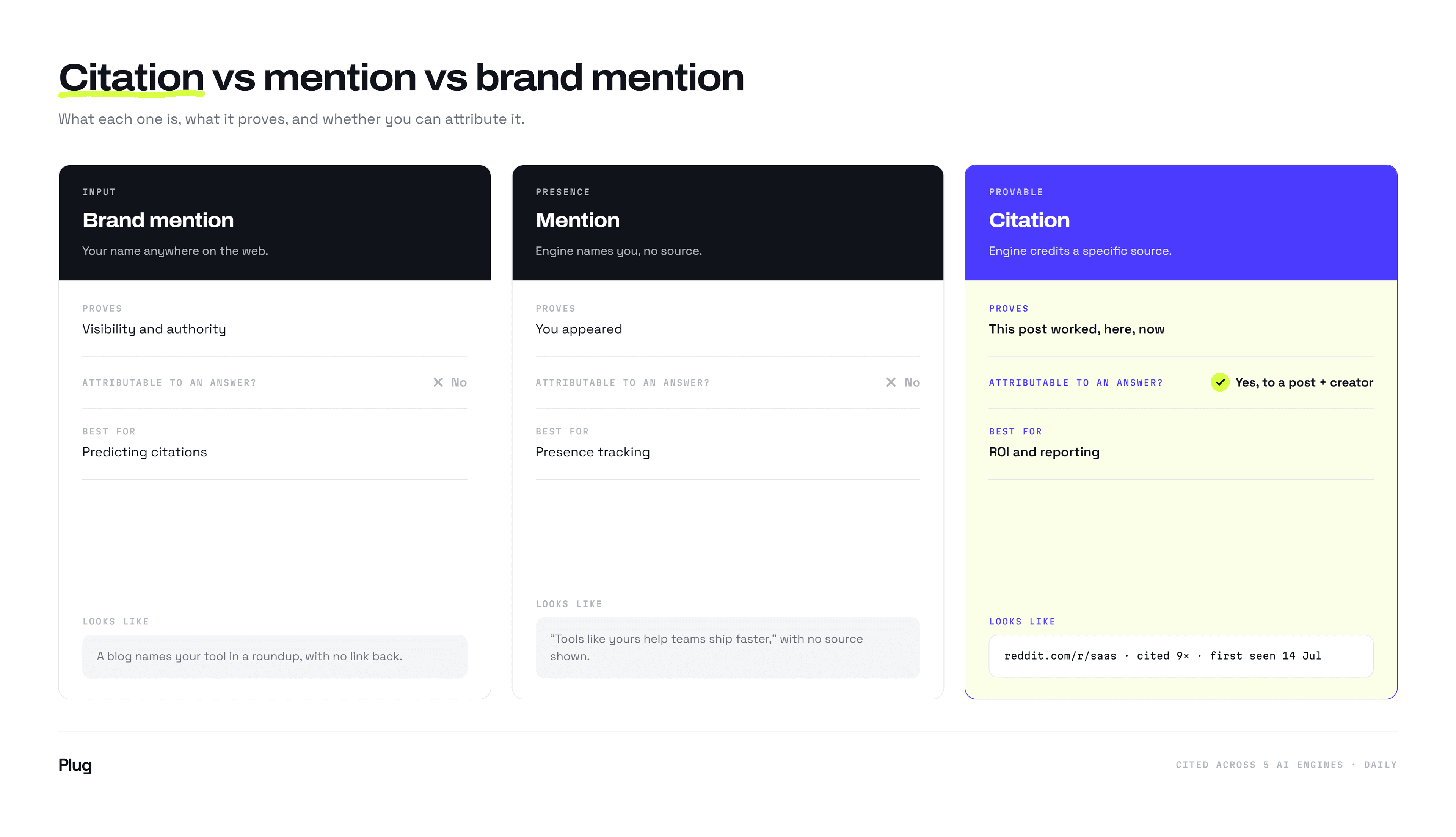
The three, side by side
The quickest way to keep them straight is to ask what each one proves and whether you can act on it. Citations prove a specific post worked and are fully actionable. Mentions prove you appeared but not why. Brand mentions predict future citations without measuring any single answer.
| AI citation | Mention | Brand mention | |
|---|---|---|---|
| What it is | Engine quotes or credits a specific source | Engine names you, no source | Your name anywhere on the web |
| Where it lives | Inside an AI answer | Inside an AI answer | Across the open web |
| What it proves | This post worked, here, now | You appeared | You have visibility and authority |
| Can you attribute it? | Yes, to a post and creator | No | Not to an answer |
| Best used for | ROI, reporting, doubling down | Presence tracking | Predicting and building citations |
Why the distinction matters
The distinction matters because you can only improve what you can measure precisely, and only citations give you that precision. Report mentions as if they were citations and your number looks great but leads nowhere, because you cannot connect it to a post, a platform or a person.
Consider a monthly report. “We were mentioned 400 times in AI answers” sounds strong until someone asks which content drove it, and the answer is a shrug. “This Reddit thread and this G2 listing were cited 30 times across ChatGPT and Perplexity for our top three buyer queries” is smaller and far more useful, because it tells you exactly what to do more of. One is a vanity metric. The other is a plan. This is the difference between reporting reach and reporting results.
How to count citations properly
Counting citations properly means recording each one once per answer, per engine, per day, and tracking it over time so changes show up as changes. AI answers are not stable: the same query returns different sources tomorrow, so a citation that disappears should register as a drop, not as silence.
A few rules keep the number honest:
- Count once per answer, per engine, per day. The same citation appearing on two engines is two data points, not one, and the same engine on two days is two checks.
- Attribute every citation to a specific post and creator. A citation you cannot trace back is a citation you cannot repeat.
- Track drops, not just gains. A placement cited this month and gone next month is information, and only continuous checking catches it.
Do this and “AI Share of Voice,” the percentage of answers in your category that cite you, becomes a real number you can move rather than a guess. As a rough benchmark, 30%, or parity with the leading platform in your category, is a reasonable first target, and in a fragmented market 15% can already be category leadership.
Where this leaves you
Track all three, but never confuse them. Brand mentions are the input you build, citations are the outcome you measure, and mentions are the in-between signal you note but cannot bank on. The teams that get AI visibility right are the ones that report citations, because a citation is the only one of the three you can tie to a post, an engine and a date.
That is the half most tools miss, because they watch your own domain rather than the off-site content engines actually cite. For the category view, start with what off-site GEO is, and for where those citations come from, see where AI gets its answers.