To report off-site AI citations, replace screenshots with receipts: log every citation as a structured record, meaning query, engine, cited URL, owner and date checked, then report four numbers on a fixed cadence: citation count, off-site share, AI Share of Voice, and net change since last period. A screenshot proves one moment. A dated citation log proves a trend a stakeholder can act on.
Everyone doing GEO work hits the same wall at the same meeting. You know AI is quoting a Reddit thread and a G2 listing about your product. You can even show it on screen. But when the VP asks "is this going up or down, and what did we do to cause it?", a screenshot has no answer. This post covers the record format, the four metrics, the slide, and the caveats to state out loud, so off-site AI visibility reports like a channel instead of a curiosity.
Why screenshots fail as AI visibility reporting
Because a screenshot is a single, undated, unrepeatable observation, and AI answers are none of those things. The same query run twice can return different sources. Personalisation, live retrieval and model updates all move the answer. So a screenshot in a deck proves that a citation existed once, on one machine, for one phrasing. It cannot show direction, coverage or cause, which is exactly what a stakeholder is asking about.
Worse, screenshots quietly report the wrong half of the problem. Only 38% of the pages cited in Google's AI Overviews also rank in its top 10, down from 76% eight months earlier, so roughly 62% of cited pages sit outside the rankings most dashboards watch. Reddit is the single most-cited domain in AI answers, and it is not your domain. If your report only shows pages you own, it is silent on the majority of what AI is actually quoting about you. That is the gap behind what off-site GEO is and why your AEO tool can't see it.
Receipts, not screenshots: the citation record format
A receipt is a structured, dated row that captures one citation completely enough for someone else to re-check it. That is the whole reframe. Stop capturing images of answers and start capturing records of citations. A receipt survives being pasted into a spreadsheet, counted, filtered and compared to last month. A screenshot does not.
Log seven fields for every citation.
| Field | Example | Why it's there |
|---|---|---|
| Query | "best off-site AI visibility tool" | The buyer question, verbatim, and the unit of measurement |
| Engine | Google AI Mode | Citation behaviour differs sharply per engine |
| Cited URL | reddit.com/r/SEO/comments/… | The actual page quoted, not "Reddit" |
| Source type | Reddit / review site / YouTube / owned | Splits off-site from your own domain |
| Owner | Creator name, or "community" | Attributes the win to whoever earned it |
| Quoted claim | "$29/month, six-minute setup" | Lets you check the quoted detail is correct |
| Date checked | 2026-08-17 | Makes it a trend line instead of an anecdote |
Two fields do most of the work. Quoted claim is the one everybody skips and the one executives care about most, because a citation that repeats a wrong price is a problem rather than a win. Owner is what turns reporting into a programme: it tells you which creator, thread or listing to invest in next, which is the same logic as briefing creators for citations, not impressions.
The four metrics that belong in a GEO report
Report four numbers and no more: citation count, off-site share, AI Share of Voice, and net change. More than four and the slide stops being read. Fewer and you cannot explain movement. Each is derived directly from the citation log above, so nothing requires a tool your team does not already have.
1. Citation count. How many distinct cited URLs mention or recommend you across your tracked query set this period. Report it per engine, because the denominators differ enormously. In a study of 602 prompts and 21,143 citations, Perplexity returned a mean of 16.35 sources per prompt, Google AI Overviews 12.06 and ChatGPT 6.88. Three Perplexity citations and three ChatGPT citations are not the same achievement, and a blended number hides that. The same study found ChatGPT cites fewest but absorbs the most from each source it keeps, so breadth and influence pull in opposite directions.
2. Off-site share. The percentage of your citations that live on third-party pages rather than your own domain. This is the number that justifies the work existing. If it is high, your marketing site is not what AI is quoting: Reddit, G2, Capterra and YouTube are.
3. AI Share of Voice. Of all brands cited on your tracked buyer queries, what share is you. The full method is in AI Share of Voice, off-site.
4. Net change. New citations gained minus citations lost since last period, with the lost ones named. Losses are not noise. Answers are unstable, and a disappearing citation is a real event worth its own line.
What "good" looks like, and why the benchmarks are softer than they sound
Stage benchmarks circulate widely: under 5% for a new entrant, 8 to 20% for a challenger, and 25 to 45% for a category leader. They are useful for framing a conversation, and worth handling carefully, because two qualifiers usually get dropped on the way into a slide.
The leader band is 25 to 45% on your best engine, not across engines combined. That distinction is large: the same brand and query set can show roughly 28 to 38% on Perplexity while sitting in single digits elsewhere. Quote it as an aggregate and you have inflated the target by two or three times. The new-entrant band is also time-bounded, meaning under 5% for the first two or three quarters, rather than a permanent ceiling.
It is also worth knowing what these numbers are not. The source publishes no study, sample size or method behind the bands, so they are industry rules of thumb rather than measurements. Use them to set expectations, not to grade yourself. A more defensible target is 30%, or parity with the leading platform in your category, with the same source making the point that relative momentum matters more than the absolute score.
The one-slide stakeholder report
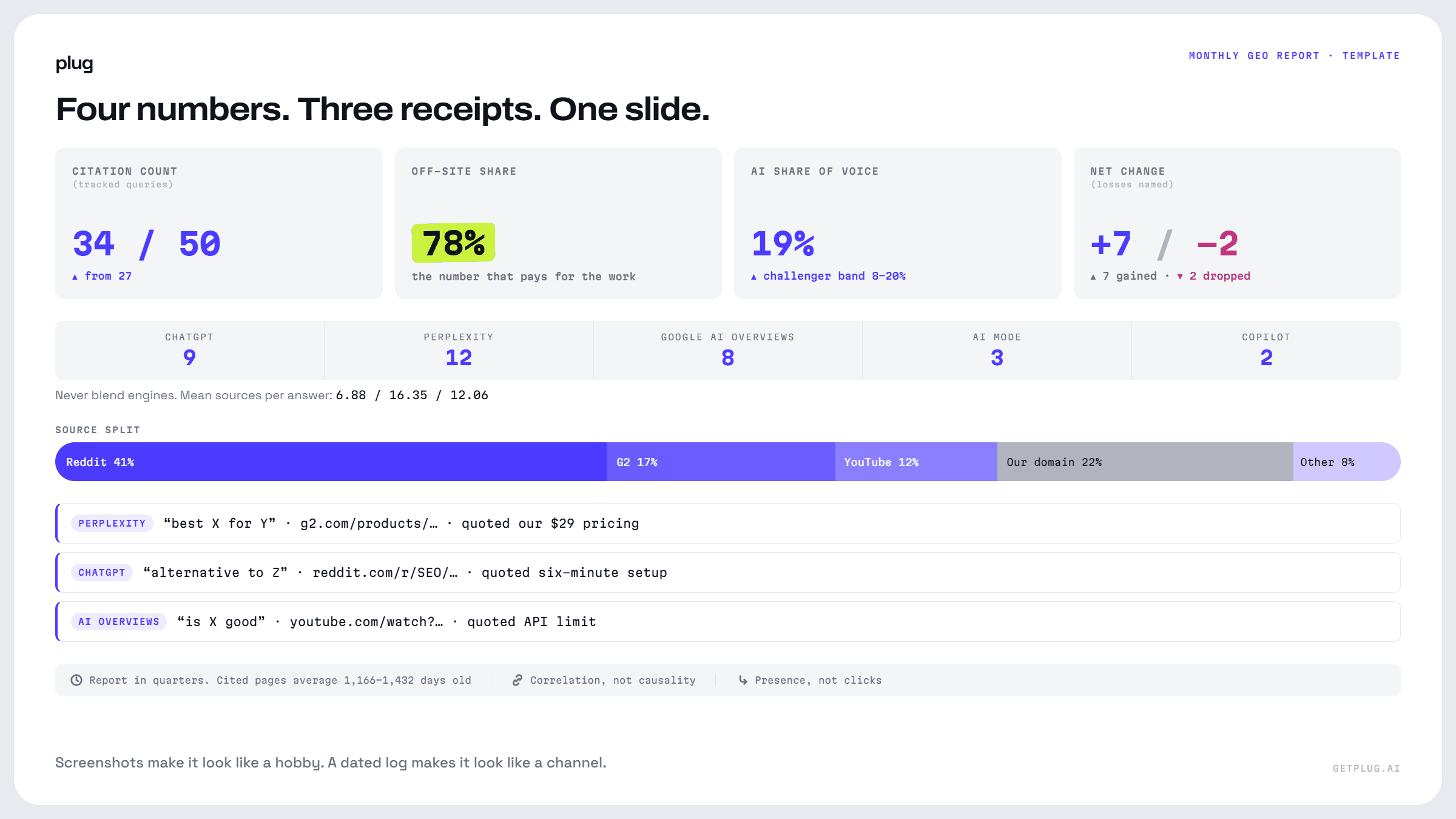
One slide, four numbers, three named receipts. Executives do not want your methodology. They want to know whether AI recommends the company more than it did last month, and where the movement came from. So the slide reads: headline number, trend arrow, then the specific pages doing the work.
A working layout:
- Headline. "Cited on 34 of 50 tracked buyer queries, up from 27. AI Share of Voice: 19%."
- Split. "78% of citations are off-site: Reddit 41%, G2 17%, YouTube 12%, our domain 22%."
- Per engine. One row per engine you track, never blended into a single number.
- Receipts. Three named cited URLs with the quoted claim, for example "Perplexity, 'best X for Y', quoted our $29 pricing from a G2 review."
- Movement. What was gained, what was lost, and the one action taken that plausibly caused it.
Then say the caveat out loud, because it protects you later: AI answers vary between runs and personalise by user, so treat any single check as a sample rather than a measurement. Report the trend across a fixed query set on a fixed schedule and the variance averages out.
What not to promise: the honest caveats
Do not promise attribution to revenue, day-one movement, or stable answers. GEO reporting earns trust by being upfront about what it cannot yet do, and loses it the first time a confident claim collapses under a follow-up question.
Three caveats to state explicitly. First, timing. Cited content skews old. In Ahrefs' analysis of 16.975 million cited URLs, pages cited by Perplexity average 1,166 days old, and Google's top three AI Overview citations average 1,432 days. Something published this month may not appear in answers for a long while, so set expectations in quarters rather than sprints. Second, causality. You can show a citation appeared after a campaign; you usually cannot prove the campaign caused it. Log the action and the citation separately and let the pattern build. Third, click attribution. A citation inside an AI answer often produces no click at all, because the buyer reads the answer and moves on. Report citations as brand presence rather than a traffic source, and do not let anyone quietly convert your citation count into a session forecast.
Cadence: how often to report, and to whom
Monthly to executives, weekly to the working team, and immediately when a top-query citation is lost. The two audiences need different resolutions of the same log. Executives need the four numbers and a trend. Practitioners need the raw receipts so they can act on individual URLs.
Keep the query set fixed for at least a quarter, because changing it mid-period makes every comparison meaningless, and check on a consistent day, since answers drift. Twenty to fifty buyer queries is enough to be stable without becoming a manual chore, and the set should be the questions your buyers actually ask rather than your keyword list. Be precise with language in the report, too: a citation, a mention and a brand mention are not the same event, and conflating them inflates your numbers. See citation vs mention vs brand mention for the definitions that survive scrutiny.
Where this leaves you
The reason GEO work stalls in most companies is not that it does not work. It is that nobody can report it, so it never gets a budget line. Screenshots make it look like a hobby. A dated citation log with four metrics and named receipts makes it look like a channel, one with coverage, direction and owners.
Build the log first, keep the query set fixed, state the caveats, and let the trend do the arguing.