A content brief for AI citations tells a creator the exact facts, numbers and named entities to state so an AI engine can lift and attribute them, rather than telling them how many views to chase. The single highest-leverage change is swapping vague praise ("it's great, I love it") for specific, verifiable claims ("$29 a month, 100 API calls a second, six-minute setup"), because adding statistics lifted a page's visibility in AI answers by 32.8% and quotations by 42.6% in the Princeton and IIT Delhi GEO study at KDD 2024. Brief for the quotable sentence, not the impression count.
Most creator briefs are written for a metric AI ignores. They optimise for reach, watch time and engagement, and then the buyer skips the post entirely and reads an AI answer that quoted it. If you want your product to show up inside those answers, the brief has to change: it has to hand the creator the precise, attributable language you want a model to pull. This post covers the reframe, the anchor-claim template, and how to tell whether any of it worked.
Why brief for citations instead of impressions?
Because the impression is no longer the end of the funnel, the AI answer is. When a creator posts a review, a growing share of buyers never see the post directly. They ask ChatGPT, Perplexity or Google what to buy, and the engine quotes the review back to them. A brief that maximises views optimises for a step the buyer increasingly skips. The retrieval engine, not the feed, is now the audience deciding whether your product gets mentioned.
The numbers make the case blunt. Only 38% of the pages cited in Google's AI Overviews also rank in its top 10, down from 76% eight months earlier, so roughly 62% of cited pages sit outside the rankings, and the reach, that teams normally watch. Briefing a creator to be citable puts your product into that off-site layer, the one your own marketing pages cannot reach. It is the same premise behind what off-site GEO is and why your AEO tool can't see it.
What makes a creator's content citable by AI
Specific, verifiable, front-loaded facts, stated in clean text a retrieval engine can extract and attribute. AI doesn't watch the video or feel the vibe. It reads the words and quotes the ones carrying information. Three properties decide whether a creator's content gets pulled.
First, fact and stat density. In the Princeton and IIT Delhi GEO study at KDD 2024, adding statistics lifted a page's visibility in AI answers by 32.8%, quotations by 42.6% and citing sources by 27.7% across 10,000 queries, while keyword stuffing hurt. A creator who says "it starts at $29 a month and onboarding took six minutes" is handing the model a quotable, attributable fact. A creator who says "it's super easy and I love it" is handing it nothing.
Second, position. 44.2% of citations are lifted from the first 30% of a document, on an analysis of ChatGPT citations, so the claim you most want quoted has to appear early: in the first spoken minute, the opening description lines, or the first paragraph, not after a two-minute intro.
Third, format. Listicles are 21.9% of AI citations and articles 16.7%, the two most-cited content types across 75,000 AI answers. Structured, sectioned, written content beats loose short-form, which is why a detailed written review or a well-captioned YouTube walkthrough outperforms a fast Reels clip. See do YouTube reviews get cited by AI for the transcript mechanic behind that.
The anchor-claim brief: the template that gets lifted
Here is the reframe worth stealing. Your brief should contain the sentences you want quoted, written in the exact language you would want an AI to repeat. Don't describe the vibe and hope the creator lands the facts. Hand them the facts. The core of a citation-ready brief is an anchor-claim block: three to five specific, verifiable statements the creator commits to stating verbatim or near-verbatim, each built to survive being lifted out of context.
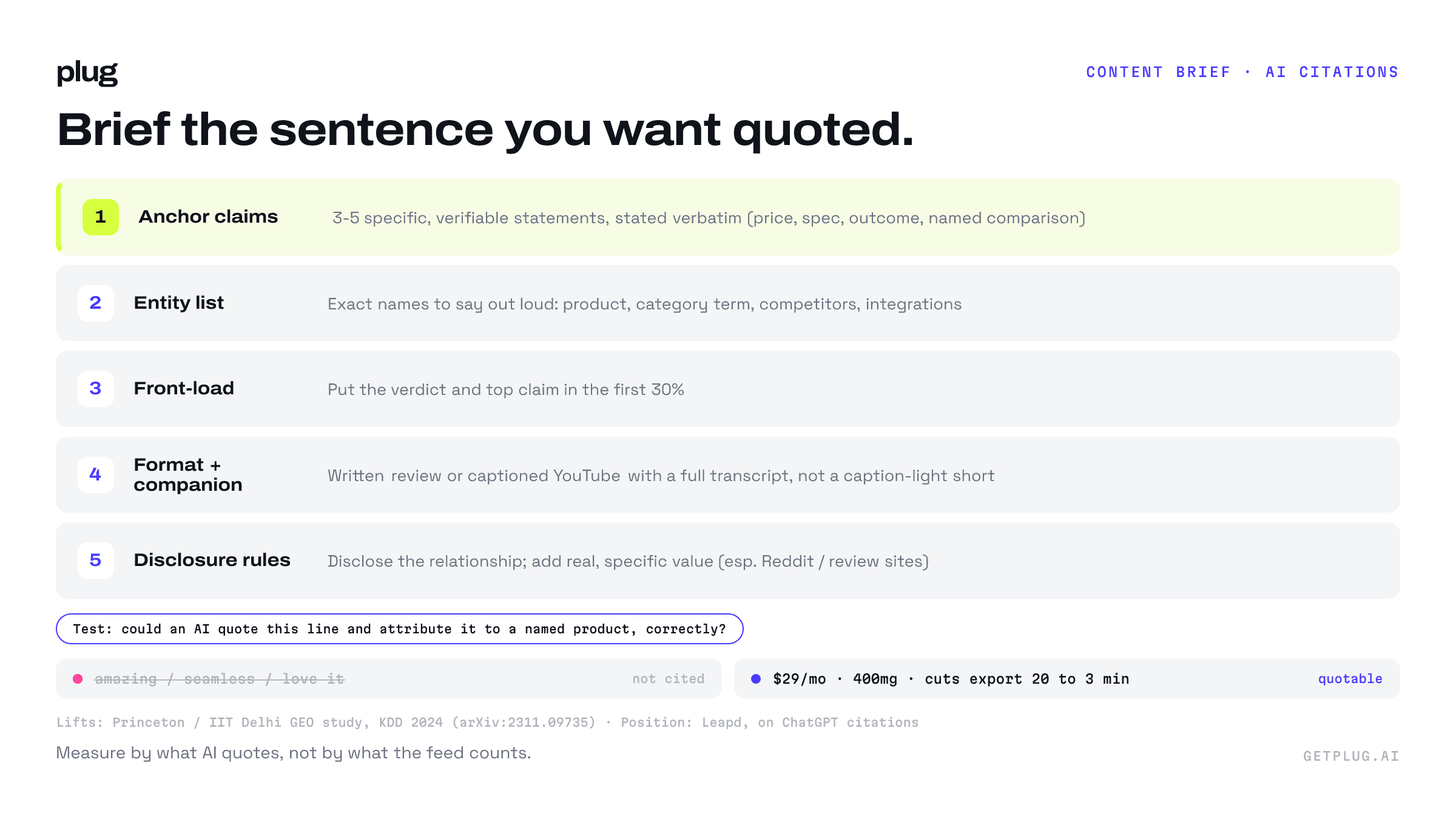
A citation-ready creator brief has five parts.
- Anchor claims, the non-negotiable core. Three to five factual statements written in quotable form: the price, a hard spec, a measured outcome, a named comparison. "Setup took six minutes." "It handles 100 API calls a second." "It's $29 a month against $79 for the nearest rival." These are the sentences an engine can pull and attribute, which is the whole point of the brief.
- Entity list. The exact names to say out loud: your product, the category term, the competitors, the integrations. A vague "this tool" cannot be attributed; a named product can. Name the engines you're targeting too, so the creator understands the audience is ChatGPT and Perplexity, not just their followers.
- Front-load instruction. Tell the creator to state the verdict and the top anchor claim in the first 30%, meaning the first spoken minute or the opening lines of the description or post, because that is where the citations come from.
- Format and companion-content spec. Ask for the citable format: a written review with a short methodology note, a YouTube video with an accurate edited transcript and timestamped chapters, or a structured listicle, not a caption-light clip. If the primary asset is a video, require a full written description, because the transcript is the page AI actually reads.
- Disclosure and platform rules. On Reddit and review sites especially, brief the creator to disclose the relationship and add real, specific value. Genuine, disclosed contributions survive where thin promo gets removed. The Reddit citation playbook covers the survival mechanics, and the brief should point creators to it.
The test for every line in the brief: could an AI quote this sentence, attribute it to a named product, and be correct? If not, rewrite it until it can.
Adjectives don't get quoted, specifics do
This is the one habit to break. Standard briefs are full of adjectives, "amazing", "seamless", "game-changing", because they're written to make the audience feel something. But adjectives carry no informational weight a model can extract or verify, so they don't get cited. Specifics do. "Third-party tested", "400mg per serving", "cuts export time from 20 minutes to 3", "free tier includes 50 exports a month". These are retrievable, attributable and checkable, which is exactly what a retrieval engine reaches for.
The GEO study quantifies the swap: quotations 42.6%, statistics 32.8%, cited sources 27.7%. So the edit isn't stylistic, it's the difference between content that gets quoted and content that gets scrolled past. Practically, every anchor claim in the brief should contain at least one number, one named entity or one verifiable outcome. If a claim is all feeling and no fact, it's decoration. Cut it or make it concrete.
How to know the brief worked: measure citations, not views
Judge a citation-first brief by whether AI quotes the content, not by its view count. This is the uncomfortable part, because the metric you're used to reporting is the one that no longer predicts the outcome you care about. A creator's review can pull modest views and still become the sentence ChatGPT repeats to every buyer who asks about your category. Another can go viral and never get cited, because it was all vibe and no fact.
So measure the right thing. Run your buyer queries, "best [category] for [use case]", "[product] review", "[product] versus [competitor]", across ChatGPT, Perplexity, Google AI Overviews and AI Mode, and log which creator content gets cited, on which engine, and whether the quoted detail is right. That is a different signal from anything an influencer dashboard shows, and it's the one telling you the brief landed. It is also the core of AI Share of Voice, off-site. Give the anchor claims time, too: cited content skews old, so a review may not surface in answers for weeks or months after it posts.
Why your AEO dashboard won't tell you if the brief worked
Because the citation you're chasing happens on the creator's page, not yours, and your AEO tool only watches your domain. Your on-site dashboard can confirm Google indexed your blog. It cannot tell you that a Perplexity answer for "best [category] tool" quoted a creator's review of you, because that decision was made on a YouTube page, a Reddit thread or a review listing your analytics never scans. The whole value of the brief lives in third-party territory, and third-party is exactly where AEO tools go dark.
That blind spot is the reason off-site tracking exists. If 62% of cited pages fall outside the top 10 and creator content sits heavily among them, then the success or failure of your creator programme is playing out on pages your own dashboards can't see. Closing that gap means running your buyer queries across the engines on a schedule, logging every cited URL, and separating your domain from the third-party pages doing the real work. Review listings follow the same rules, covered in how AI reads your G2 and Capterra listings.
Where this leaves you
A brief written for impressions optimises for a step the buyer now skips. A brief written for citations hands the creator the exact facts, numbers and names you want an AI to quote: anchor claims up front, specifics over adjectives, a citable format, and disclosure where the platform demands it. Then you measure it by what AI quotes, not by what the feed counts.
Do that, and "the review got 30,000 views" turns into "ChatGPT quotes our pricing from that review, on the right query, with the number stated correctly."