One AI visibility tool has a genuine perpetual free tier as of 18 August 2026: AthenaHQ's Essential plan, free with $25 of credit across five engines. Plug is free during early access with unlimited queries across 3 engines, but that is a starting phase with no published end date, not a permanent tier. Sauce, VerseOdin, Profound, Peec AI, Otterly.ai and Scrunch offer trials. You can also track citations manually for nothing, at roughly 75 minutes a week.
Disclosure: Plug is one of the $0 options below, and we build it. Everything about the other vendors comes from their own published pages, fetched on 18 August 2026 and date-stamped, because free-tier terms change faster than anything else in this category.
The manual method in the middle of this post costs nothing and involves no tool at all, including ours. It is there because it works, and because a post about free options that skips the actually-free option is an advert.
"Free" means four different things here, and vendors blur them
Sort every offer into one of four buckets before you compare anything.
A free tier runs indefinitely with a cap: credits, queries, or features. You can build a habit on it. When you hit the cap you decide whether to pay, and until then nothing stops. Only AthenaHQ qualifies in this set.
A free trial runs for a fixed, published number of days and then stops. It is an evaluation window, not a programme. A 7-day trial cannot tell you whether a citation is durable, because durability is measured in months.
A free report is a one-off scan, usually gated behind an email. Useful as a first look, useless as measurement, since a single snapshot has no baseline to compare against. Siftly, Pierview and Profound all offer one.
Free during early access is the awkward fourth case, and it is where Plug sits. It behaves like a tier while it lasts, with no credit meter and no countdown on screen. But it is a starting phase, it will convert to paid, and no end date has been published. That is not a criticism of the model, plenty of good products launch this way. It is a warning about how you plan around it.
We are putting our own product in the least flattering of the four buckets deliberately. On this post's own definitions, "free tier" means indefinite, and Plug's $0 is not indefinite. Calling it a free tier alongside AthenaHQ's would be the kind of small self-serving stretch that costs more credibility than it wins signups.
The gap between buckets is wider than the word suggests. VerseOdin's 14-day trial converts to $799/month. Siftly's free audit converts to a price they do not publish. Plug's early access converts to something nobody has announced yet. "Free" is doing a lot of work across a range that runs from genuinely zero to eight hundred dollars.
The practical rule: only the first bucket is safe to build a multi-quarter budget on. For everything else, including ours, assume a price arrives and decide now whether you would pay it.
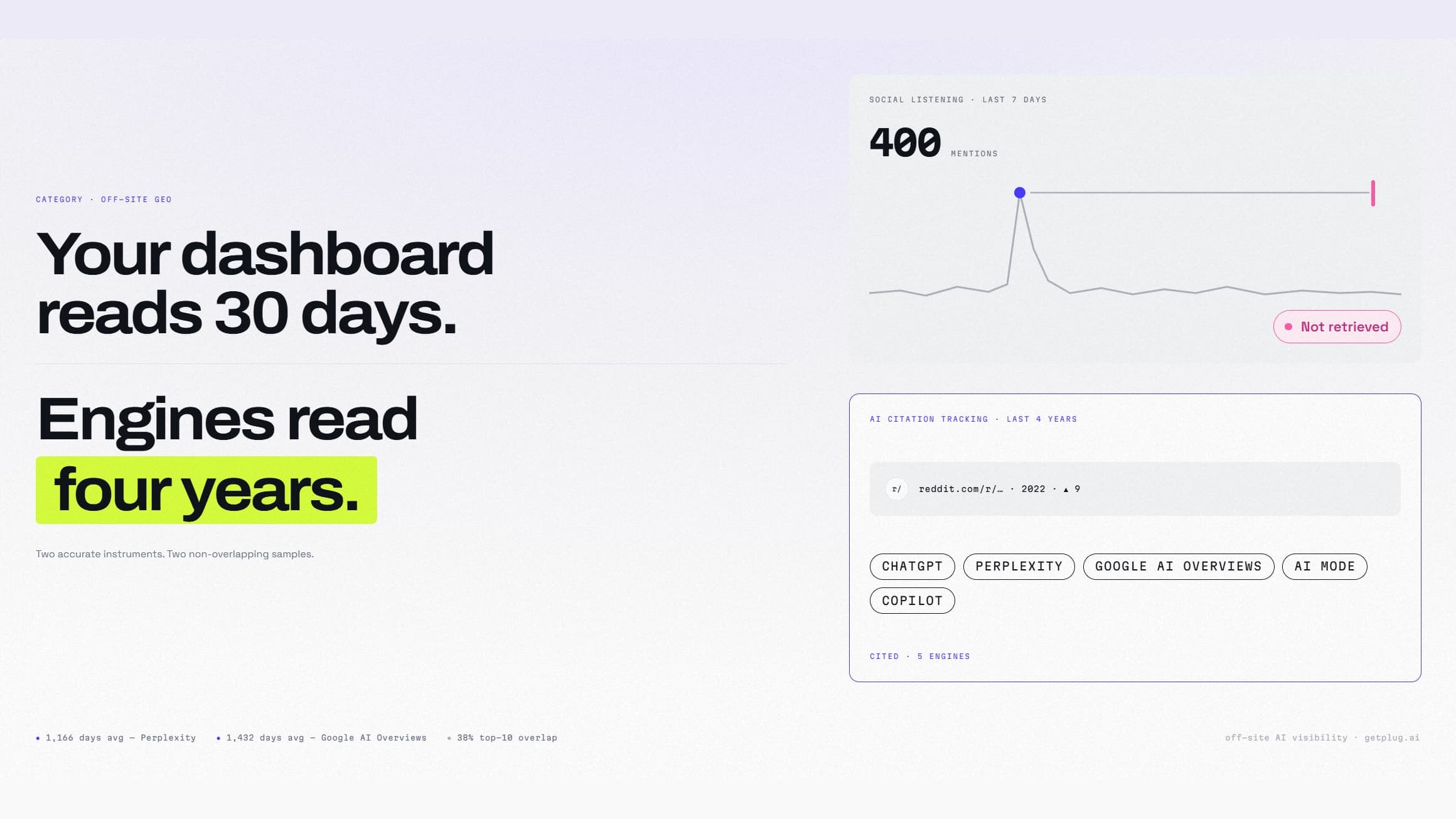
The distinction matters more in this category than in most software, because the thing you are measuring moves. A number today with nothing to compare it against tells you almost nothing. Pages cited by Perplexity average 1,166 days old, with a 1,064-day mean across AI assistants (Ahrefs, 16.975M cited URLs), roughly three years. You are studying a slow system with a fast dashboard, and a week-long window is the wrong instrument.
The free tiers that actually exist
Verified from vendor pages, 18 August 2026.
| Type | What you get | The cap | |
|---|---|---|---|
| AthenaHQ Essential | Free tier (perpetual) | 5 engines: ChatGPT, Perplexity, Google AI Overviews, Gemini and Copilot | $25 of credit, 300 credits |
| Plug Early access | Free during early access | 3 engines, unlimited tracked posts, unlimited buyer queries, runs daily to monthly, creator attribution, drop alerts, CSV export | Ends when early access ends. No date published. |
| Sauce | Trial | 7-day Pro trial; paid plans from $49/mo | 7 days |
| VerseOdin | Trial | 14-day trial, no credit card; then $799/mo | 14 days |
| Profound | Trial + free report | "Try for free" on Growth; a free AEO report tool | Fixed window |
| Otterly.ai | Trial | Free trial for new users | Fixed window |
| Peec AI | Trial | "Start Free Trial" | Fixed window |
| Scrunch | Trial | 7-day free trial | 7 days |
| Siftly | Free report | "Free AI Visibility Audit" | One-off scan |
| Pierview | Free report | Free brand audit | One-off scan |
Worth flagging if creator attribution is what you're after. Resolving a citation to the person who wrote the post is uncommon, and none of the broad suites above describe doing it. The tools that do are Sauce from $49/mo, Scribble Network from $1,500/mo on its published Custom tier, and Plug. Only Plug has a free tier. So if you need creator-level data on a $0 budget today, the choice is narrow, and that is worth knowing rather than discovering it three tools in.
AthenaHQ: the widest free engine coverage
Essential is free with $25 of credit (300 credits), covering five engines: ChatGPT, Perplexity, Google AI Overviews, Gemini and Copilot. That is still the broadest engine list you can touch without paying, wider than Plug's free three, and it includes Gemini and Copilot, which Plug's free tier does not. Claude, Grok and DeepSeek sit behind the paid Starter tier, which reaches ten models at $295/month.
Credits are consumed as you run queries, so this is a sample, not a running programme. Use it to answer "what does this data even look like for us?" before you write a business case. It will not give you a trend line, because a trend needs repeated measurement and repeated measurement burns credits.
Plug: unlimited queries, narrower engines, and a clock you can't see
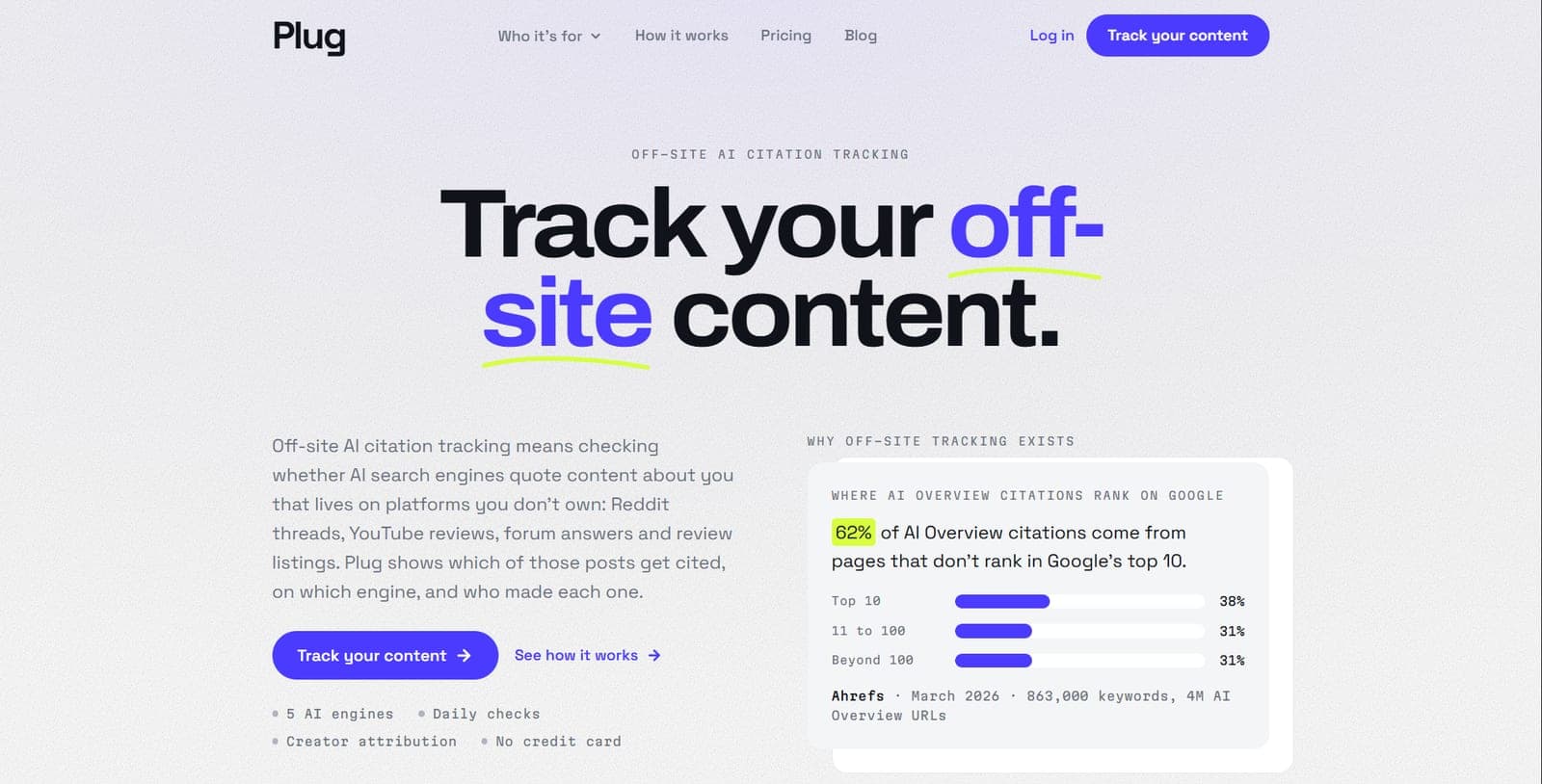
Ours. Free during early access with unlimited tracked posts and unlimited buyer queries, no credit card, across ChatGPT, Google AI Overviews and Google AI Mode. Runs daily through monthly on a cadence you set, and creator attribution, trend tracking, drop alerts, stakeholder reports and CSV export are all included.
Three honest caveats, and the third is the one that matters most for a post about free options.
The engine list is narrower. No Claude, Gemini, Grok or DeepSeek, so if those matter to your buyers this is not enough on its own.
AthenaHQ gives you more engines for a limited number of looks; Plug gives you unlimited looks at fewer engines. Which is right depends on whether you need breadth once or depth continuously.
And the $0 is temporary. Plug is in a starting phase. That phase will end, the product will be paid, and we have not set a date for when the free access closes. Our pricing page commits to announcing changes before anything happens, with plenty of notice, and that commitment is real. But it is a commitment about how we will tell you, not about whether the price arrives.
So plan accordingly: use it now, get your baseline built while it costs nothing, and decide early whether the tool is worth paying for rather than assuming the question will not come up. If a permanent $0 is a hard requirement for your team, AthenaHQ's credit-capped Essential tier is the only option in this comparison that meets it, and the manual method below meets it for good.
And a third caveat, since it belongs here. Plug is not the only tool built for off-site content and creator attribution. Sauce does the same job across 14 named platforms, with a reporting layer Plug does not have (Search Console import, AI referral traffic, content briefs, creator leaderboards). Scribble Network does the attribution too, bundled with a 50,000-creator bounty network that produces the content as well as measuring it. Neither has a free tier, which is the only reason both sit outside the free column above. If your budget is genuinely $0 today that settles it, but if a budget appears next quarter, compare them properly rather than defaulting to whichever you started on. The comparison is in best AI citation tracking tools.
The trials, and what a week can honestly tell you
A trial is worth running, but be clear about what it can establish.
It can tell you: whether the interface fits how your team works, whether the tool finds sources you did not know about, whether the raw answer evidence is good enough to show a stakeholder, and whether export works.
It cannot tell you: whether your citations are stable, whether a drop alert fires correctly, or whether the trend goes the right way. All three need months.
Run all your trials against the same query list in the same week. Different queries or different weeks and you are not comparing tools, you are comparing days.
How to track AI citations for $0, manually
No tool, no trial, no card. This is what we would do with no budget, and it is a legitimate baseline that a surprising number of teams skip straight past.
Time cost, stated honestly: 15 queries across 5 engines is 75 checks. At about a minute each, that is roughly 75 minutes a week. That is the real price. If your time is worth more than a subscription, the maths favours a tool, and knowing that is itself a useful result.
Step 1: write 10 to 20 real buyer questions.
Not keywords. The actual sentences a buyer types: "best tools for X", "is X worth it", "X vs Y", "how do I do X". This list is the whole foundation, and it is the same list any paid tool would ask you for, so the work is not wasted if you upgrade later.
Step 2: run each query on each engine, logged out.
Use a logged-out or private window. Personalisation and chat history will contaminate the result and make your data non-comparable week to week. Same browser state every time.
Engines worth covering: ChatGPT, Perplexity, Google AI Overviews, Google AI Mode, Copilot. Add Gemini and Claude if your buyers use them.
Step 3: log these columns.
| Column | Why |
|---|---|
| Date | Your entire trend depends on this |
| Engine | Never blend engines. See below |
| Query | Verbatim |
| Are we mentioned? | Y/N |
| Are we cited with a link? | Y/N. Different outcome, different value |
| Every cited URL | The actual list. This is the valuable column |
| Which competitors appear | Your denominator |
| Notes | Which claim got lifted, anything odd |
The cited-URL column is the one that pays for the exercise. It tells you which off-site pages the engines are actually reading about your category, and those pages are where the work goes.
Step 4: never blend engines.
Report per engine, always. ChatGPT cites a mean of 6.88 sources per answer, Google AI Overviews 12.06 and Perplexity 16.35 (arXiv 2026, via AuthorityTech). Appearing in three citations on ChatGPT and three on Perplexity are very different achievements. Averaging them destroys the number before you have reported it. The conventions are in AI Share of Voice, off-site.
Step 5: same day, same time, every week.
Answers change between runs. Consistency in your sampling is the only thing that makes week two comparable to week one, and it matters more than the sample being large.
What this manual method cannot do. Worth knowing before you commit 75 minutes a week to it:
- No history before today. You start from zero and there is no way to backfill.
- No drop alerts. You will notice a lost citation up to a week late, and only if you are reading carefully.
- No creator attribution unless you maintain the mapping from URL to author yourself, by hand.
- It degrades under load. At 40 queries it is most of a day a week, and the first thing to slip is consistency, which is the one thing that made it work.
What you cannot get for free, at any tier
Continuous coverage of every engine. No free option covers all of them. Breadth and continuity are the two axes and every free tier picks one.
Historical data from before you started. Nobody sells you the past. This is the strongest argument for starting a free tier or a manual log today rather than when the budget arrives, because the baseline you do not build now is the comparison you will not have next quarter.
Someone to do the work. No tool earns citations, free or paid. That work is off-site: Reddit is referenced in roughly 40% of AI answers (Semrush, 150,000 citations, via MaxAEO), and domains with active G2 or Capterra profiles show roughly 3x higher citation probability (Leapd). The playbook is in how to get cited on Reddit by ChatGPT and G2, Capterra and review sites.
When to start paying
Four triggers, in the order they usually arrive:
- Your query list passes about 30. Manual tracking stops being viable and credit-metered free tiers run dry.
- Someone asks "did we lose a citation?" Answering that requires history and alerting, which is where free stops.
- You are paying creators. The moment money moves, you need attribution good enough to decide who gets commissioned again, which is the argument in briefing creators for citations, not impressions.
- You have to report to someone quarterly. Manual logs do not survive contact with a stakeholder deck. The format that does is in how to report off-site AI citations to stakeholders.
Until one of those is true, a free tier plus a spreadsheet is a genuinely defensible programme, and saying otherwise would be selling you something. The full evaluation framework for when you do buy is in how to choose an AI visibility tool, and the paid landscape is in best AI citation tracking tools.