The best AI citation tracking tool depends on which question you're funding. Profound suits enterprise teams needing nine engines and SOC2. Otterly.ai has the clearest price ladder, from $29/mo. AthenaHQ offers a genuine free tier. Sauce, Scribble Network and Plug are built for off-site content and attribute citations to the creator behind each post, at $49/mo, $1,500+/mo and $0 respectively, though Plug's $0 is an early-access period rather than a permanent tier. Prices verified 18 August 2026.
AI citation tracking is the practice of running a fixed set of buyer questions against AI engines and logging which specific URLs each one cites, so a brand can see whether it appears in the answers buyers actually read. It is not rank tracking, and it is not traffic reporting. The tools below all do that job; what separates them is what they attribute a citation to, whether you can choose what gets watched, and what their meter counts.
We build one of the tools on this list, so read the ranking with that in mind. It is organised by job to be done rather than by score, and Plug is not at the top. That is deliberate: a vendor roundup that crowns its own product is worth nothing to you and, on the evidence, does not get quoted either.
Every price, engine count and feature claim below was taken from the vendor's own live pages on 18 August 2026 and is date-stamped for that reason. This category ships fast. A number that was true last quarter is not evidence today.
Let's clear up the thing most roundups get wrong
Tracking citations on pages you don't own is not a rare feature. It is worth saying plainly before the comparison, because a lot of category content implies otherwise, including some of ours.
Peec AI's own homepage names LinkedIn, a subreddit, NYT articles and G2 as sources it surfaces. AthenaHQ sells "citation source analysis". Most serious tools in this category resolve citations to a URL, and that URL is frequently somebody else's domain. If a tool tells you which sites AI cites, it is already looking off-site.
What genuinely differs between these products is narrower, and more useful once you see it:
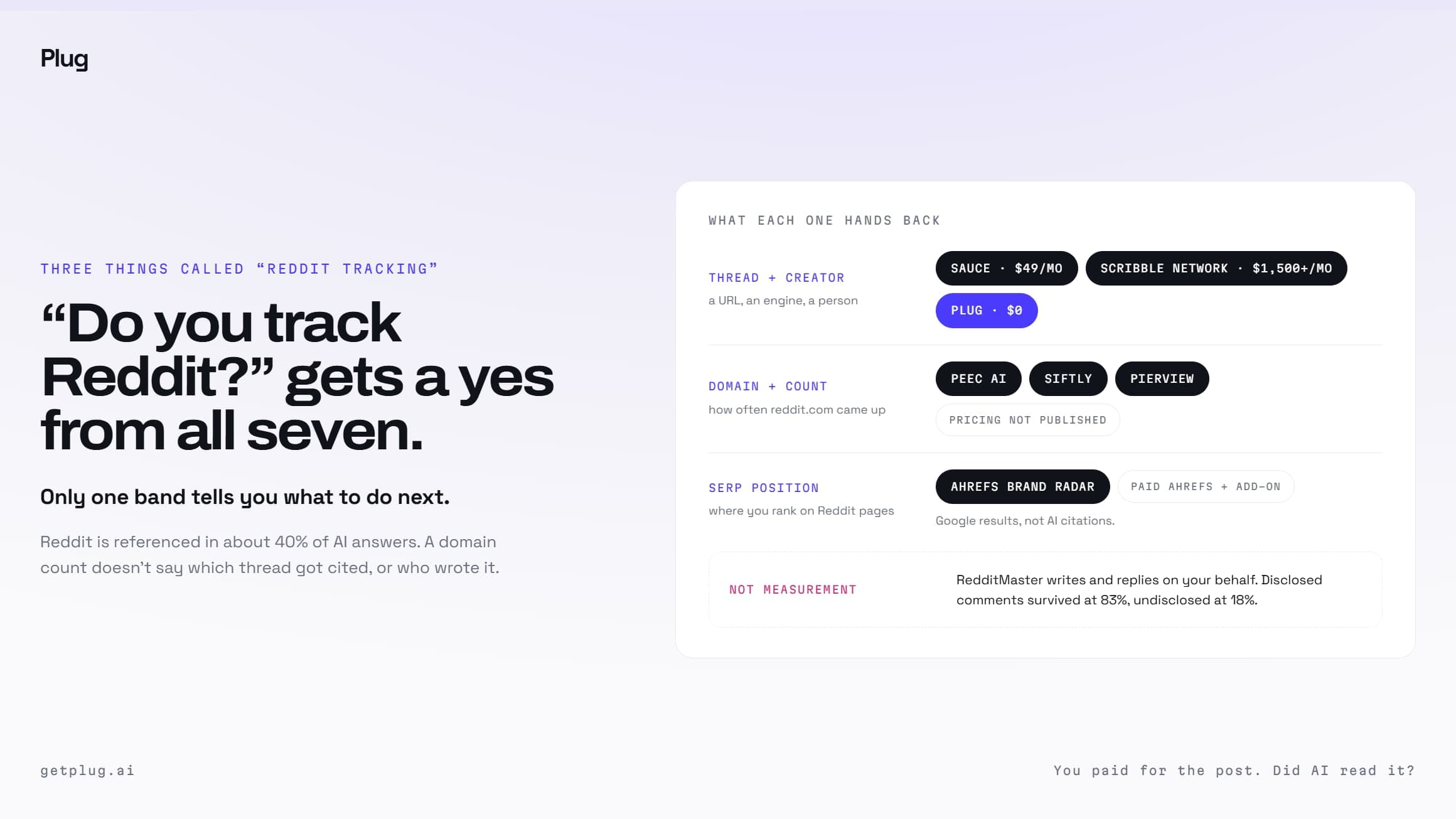
- What the citation is attributed to. Most tools here attribute a citation to a source: a domain, or a page. Sauce, Scribble Network and Plug attribute it to a person, the creator who wrote the post. That is a different data model, and it is the main fault line in this list.
- Whether you choose what gets watched. Discovery tools tell you what showed up. Some workflows need the opposite: you commissioned twelve placements and you want to know what happened to those twelve. The off-site tools work this way; the suites do not describe it.
- What the meter counts. Prompts, credits, checks, or nothing. This decides your real cost more than the sticker price does, and "checks per month" in particular is easy to misread.
Hold those three and the table below stops looking like eleven versions of the same product. It is really three categories: broad suites that discover brand presence across AI answers, off-site measurement tools built to track content you nominate, and off-site programmes that supply the creators and the content as well as the measurement.
TL;DR: 11 AI citation tracking tools compared at a glance
Verified from each vendor's own live pages, 18 August 2026. A tick means the capability is confirmed on their public pages. "Not stated" means the capability is not described there, which is not the same as the product being unable to do it. We have been wrong about this twice already, so the column says what we can see rather than what we assume.
| Tool | Type | Entry price | What that price buys | Engines | Meter | Creator attribution | Free tier |
|---|---|---|---|---|---|---|---|
| Profound | Suite | $99/mo, billed yearly | ChatGPT only, 50 prompts | Up to 9 at Enterprise | Prompts | Not stated | No, trial only |
| Peec AI | Suite, off-site-aware | Not published | Starter tier, annual billing | 6 named | Not published | Not stated | No, trial only |
| Otterly.ai | Suite | $29/mo | 15 prompts, 4 engines | 4, plus 3 paid add-ons | Prompts | Not stated | No, trial only |
| AthenaHQ | Suite, off-site-aware | Free, then $295/mo | $25 credit, 300 credits | 5 free, up to 10 at Starter | Credits | Not stated | ✅ Yes, credit-capped |
| Siftly | Suite, off-site-aware | Not published | Free audit available | 4 | Not published | Not stated | Free audit only |
| VerseOdin | Suite | $799/mo | Starter Monitoring | 6 | Not published | Not stated | No, 14-day trial |
| Scrunch | Suite | Not published | Not published | 5 | Not published | Not stated | No, 7-day trial |
| Pierview | Suite | Not published | Free brand audit | Not listed | Not published | Not stated | Free audit only |
| Sauce | Off-site | $49/mo | 5 checks/month, 25 queries | 3 at entry, 6 on Pro | Checks | ✅ Yes, all tiers | No, 7-day trial |
| Scribble Network | Off-site programme | $1,500+/mo (Custom) | Managed campaigns, 20+ content/mo, 50k creators | 5 | Not published | ✅ Yes | No, trial only |
| Plug | Off-site | $0 early access | Unlimited posts and queries, daily | 3 (ChatGPT, AI Overviews, AI Mode) | None | ✅ Yes | ⚠️ Early access, no end date set |
Published entry prices span $0 to $799 for products that sound identical on their homepages. VerseOdin's Starter Monitoring at $799/mo and Otterly's Lite at $29/mo are both "AI visibility monitoring". Half the category does not publish a price at all. That spread is the single best argument for working out which tier you belong in before you take a demo.
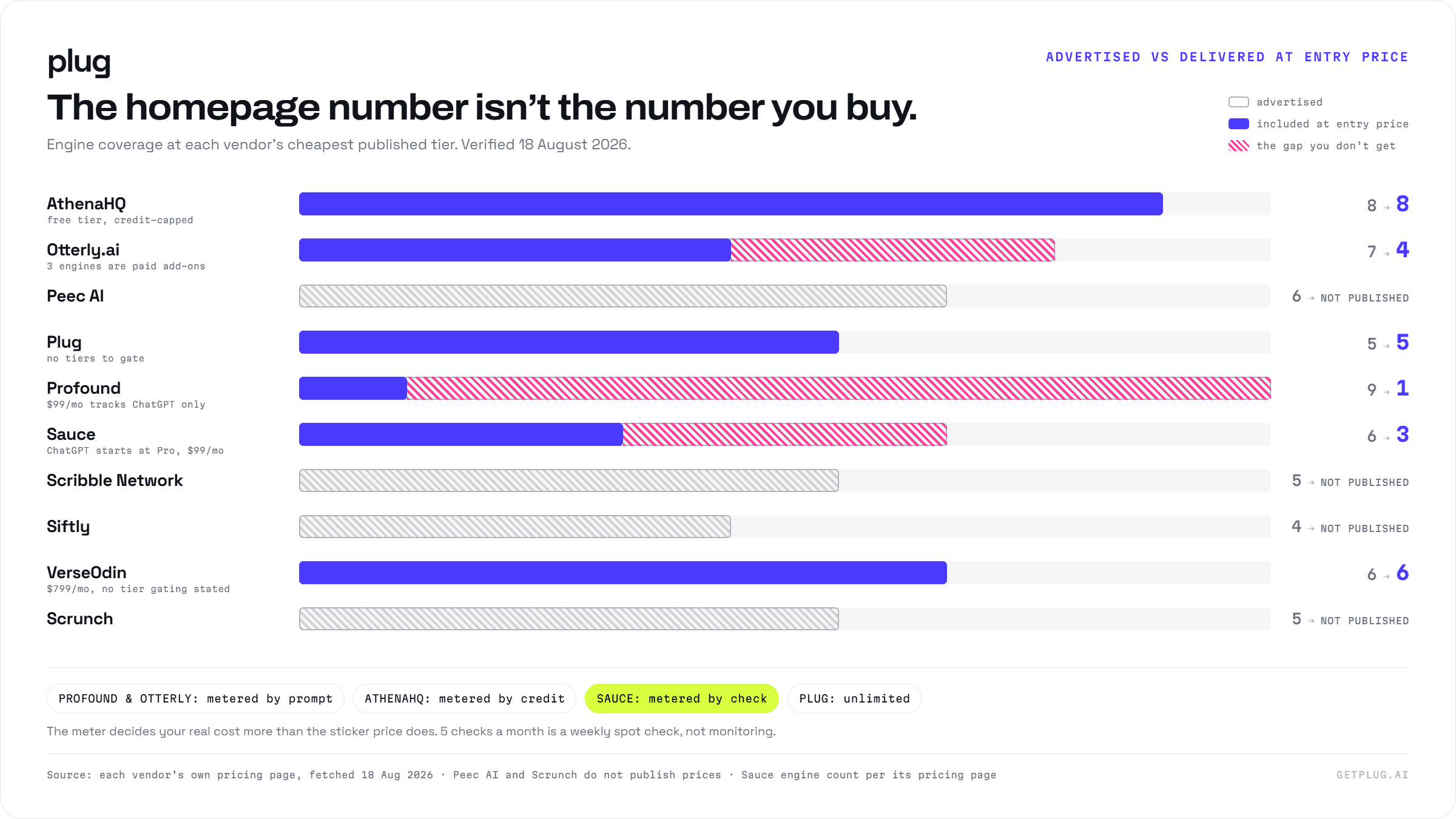
The chart above is the shortest version of this whole post: the homepage number is not the number you buy. Every hollow bar is what a vendor advertises; every solid bar is what the cheapest published tier actually includes. The gap is the part nobody puts in their marketing.
Three things in that table deserve more than a row.
Profound's $99 tier tracks one engine. The headline "up to 9 answer engines" is real but it belongs to Enterprise. At $99/mo you get ChatGPT. At $399/mo you get three. If you are comparing entry prices across this category, compare what each one actually buys, not what the homepage advertises.
Otterly meters hard at the bottom. $29/mo buys 15 search prompts. That is a genuine price, and 15 prompts is a genuinely small query set for a real buyer-question list. The ladder is honest and public, which is more than most of this category manages, but plan for $189/mo if you have a hundred questions worth asking.
Sauce meters by check, which is a different axis entirely. Its $49 Starter tier includes 5 checks per month. A check is a full run of your queries, so five of them is roughly one run a week. That is a spot-check cadence rather than a monitoring cadence, and it is easy to misread as generous because the number sits next to unlimited-sounding features. Unlimited checks begin at Sauce's Team tier, $299/mo.
Worth knowing before you buy anything: if you already pay for Ahrefs, some of this may be included. Ahrefs announced Reddit and YouTube tracking for Brand Radar in December 2025, scanning video descriptions, transcripts and titles for mentions, and tracking where brands appear in Reddit results in Google Search. It was in beta for paid Ahrefs customers at that announcement, with a plan to move into Brand Radar add-ons afterwards. That was eight months before this post, so check the current terms rather than trusting the date. Creator attribution and URL seeding are not stated in that announcement.
Which AI citation tracking tool is right for you?
Eleven entries below, in the order we think they are useful rather than in rank order, since nothing here is scored. Every price and engine count is the one published on 18 August 2026.
Profound: best for enterprise breadth and compliance
Positioned as "Optimize Your Brand's Visibility in AI Search". The engine list is the widest we verified, and the Enterprise tier is the only one in this comparison that publishes formal security credentials, which is usually what decides a purchase once procurement gets involved.
Key features
- Engine coverage: Perplexity, ChatGPT, Claude, Gemini, Grok, Microsoft Copilot, DeepSeek and Google AI Overviews
- Agents credits: 100 per month on Starter, 400 per month on Growth
- Enterprise controls: multiple tracked companies, dedicated Slack support, SSO/SAML and SOC2
- Metered by prompt: 50 at Starter, 100 at Growth
Pros
- The widest verified engine list in this comparison
- The only vendor here publishing SOC2 and SSO/SAML
- A published ladder, so you can see the shape of the spend before a call
Cons
- The $99 tier tracks ChatGPT alone, against nine engines advertised
- Three engines costs $399/mo, which is four times the entry price
- Creator attribution, URL seeding and off-site scope are not stated
Pricing
- Starter, $99/mo billed yearly: ChatGPT only, 50 prompts, 100 Agents credits
- Growth, $399/mo billed yearly: 3 engines, 100 prompts, 400 Agents credits
- Enterprise, custom: up to 9 engines, multiple companies, SSO/SAML, SOC2
- No perpetual free tier, though Growth offers a free trial
Buy it when procurement has a security questionnaire and you need coverage of engines outside the mainstream five. Skip it when your budget is the constraint, because the tier that fits most small teams tracks ChatGPT alone. A tier-by-tier breakdown against six cheaper tools is in Profound alternatives.
Peec AI: best for third-party source discovery
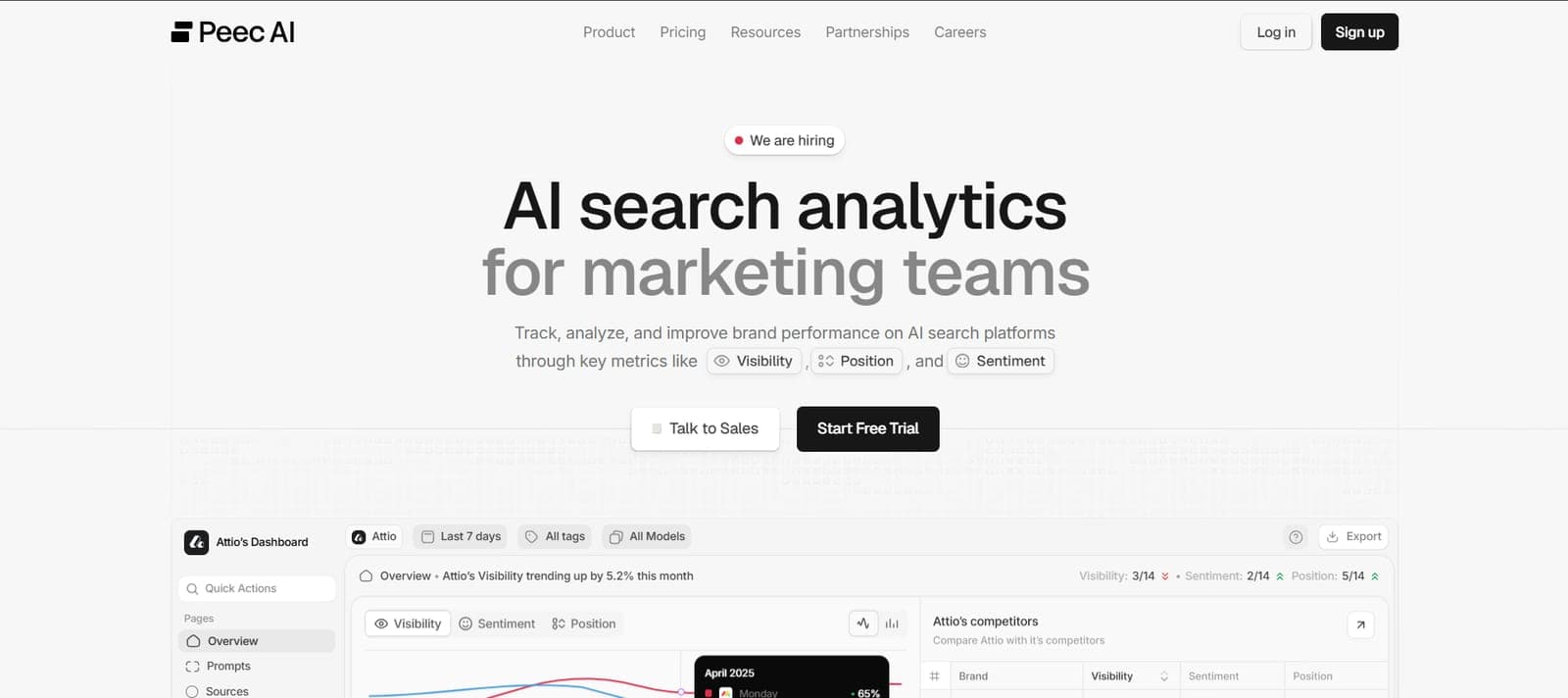
"AI search analytics for marketing teams". Peec is the most explicit vendor in the set about surfacing sources you don't own, and its own copy names the platforms it finds you on rather than describing them in the abstract.
Key features
- Six engines named: ChatGPT, Gemini, Perplexity, Microsoft Copilot, AI Mode and AI Overviews
- Daily tracking
- Off-site source discovery stated on their own pages, naming LinkedIn, subreddits, NYT articles and G2
- Higher tiers add Looker, API, MCP and SSO
Pros
- The clearest public statement in this set that it surfaces pages you do not own
- Daily tracking at the entry tier
- Six engines named rather than a vague "leading LLMs"
Cons
- No prices published on the pricing page as of 18 August 2026, so budgeting needs a sales conversation
- Annual billing only across all four tiers
- Creator attribution and URL seeding are not stated
Pricing
- Four tiers: Starter, Pro, Advanced and Enterprise, on annual billing
- No prices published on the pricing page as of 18 August 2026
- Free trial offered, which is a trial rather than a free tier
Buy it when you want to know which third-party sources AI is pulling you from and you can absorb a sales call. Watch out for the pricing opacity: you cannot plan a budget from their site.
Otterly.ai: best for a predictable, published price
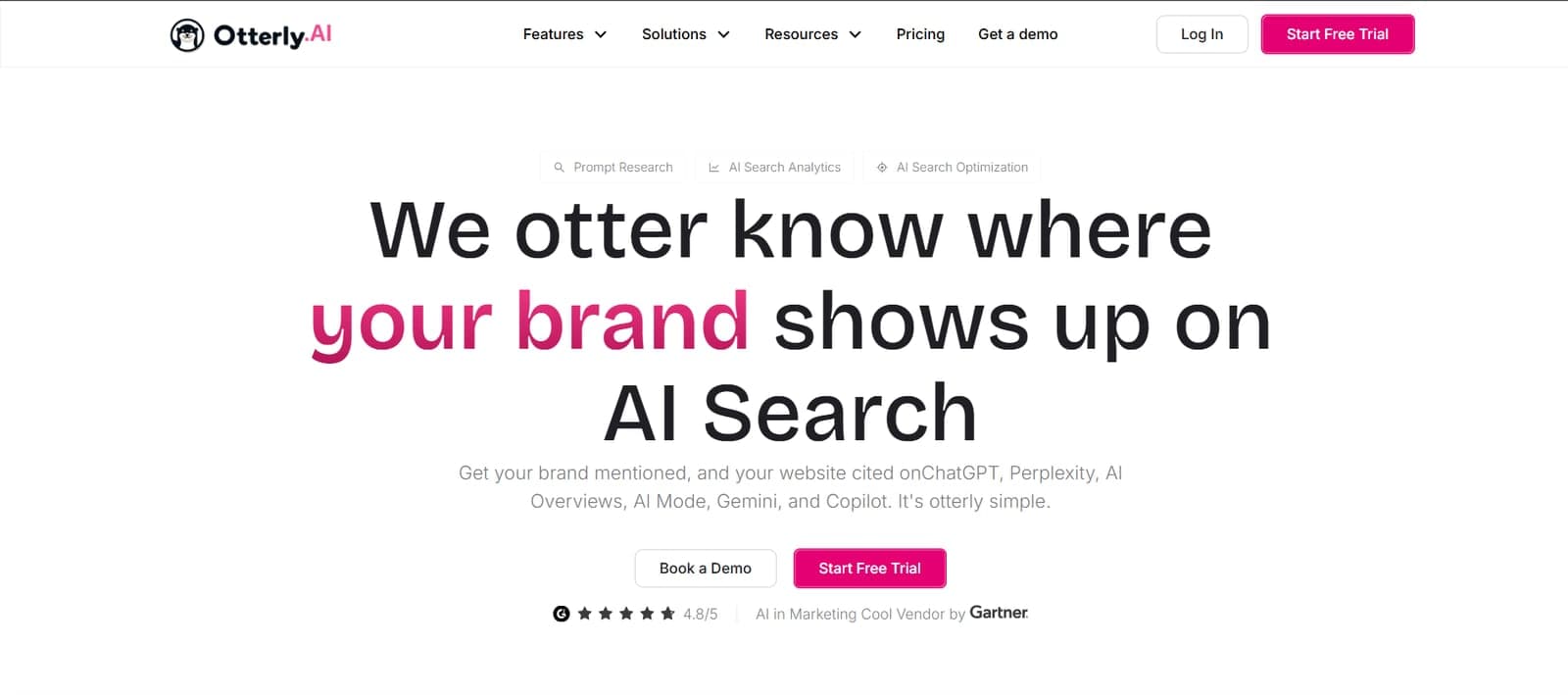
The clearest price ladder in the category, and the only vendor here where you can work out your annual cost without talking to anyone. Unlimited team members on every tier is unusual and genuinely good.
Key features
- Four engines tracked: ChatGPT, Google AI Overviews, Perplexity and MS Copilot
- Claude, Google AI Mode and Gemini available as paid add-ons
- Unlimited team members on every tier
- Daily tracking and ChatGPT Ads tracking on all tiers
- GEO URL audits: 1,000, 5,000 or 10,000 per month by tier
Pros
- The most transparent pricing in this comparison, published in full
- Unlimited seats at every tier, which most vendors charge for
- 15% discount on annual billing, published rather than negotiated
Cons
- 15 prompts at $29/mo is a small query set for a real buyer-question list
- Gemini and Claude are add-ons, so the base price is four engines rather than seven
- Creator attribution and off-site scope are not mentioned on the pricing page
Pricing
- Lite, $29/mo: 15 prompts
- Standard, $189/mo: 100 prompts
- Premium, $489/mo: 400 prompts
- Enterprise, from $1,000/mo
- Annual billing at 15% off: $25, $160 and $422 per month
- Trial for new users, which is a trial rather than a free tier
Buy it when you want to know your annual cost before you talk to anyone. Watch out for the add-on list if Gemini or Claude matter to you, because they are not in the base price.
AthenaHQ: best for trying this without a contract
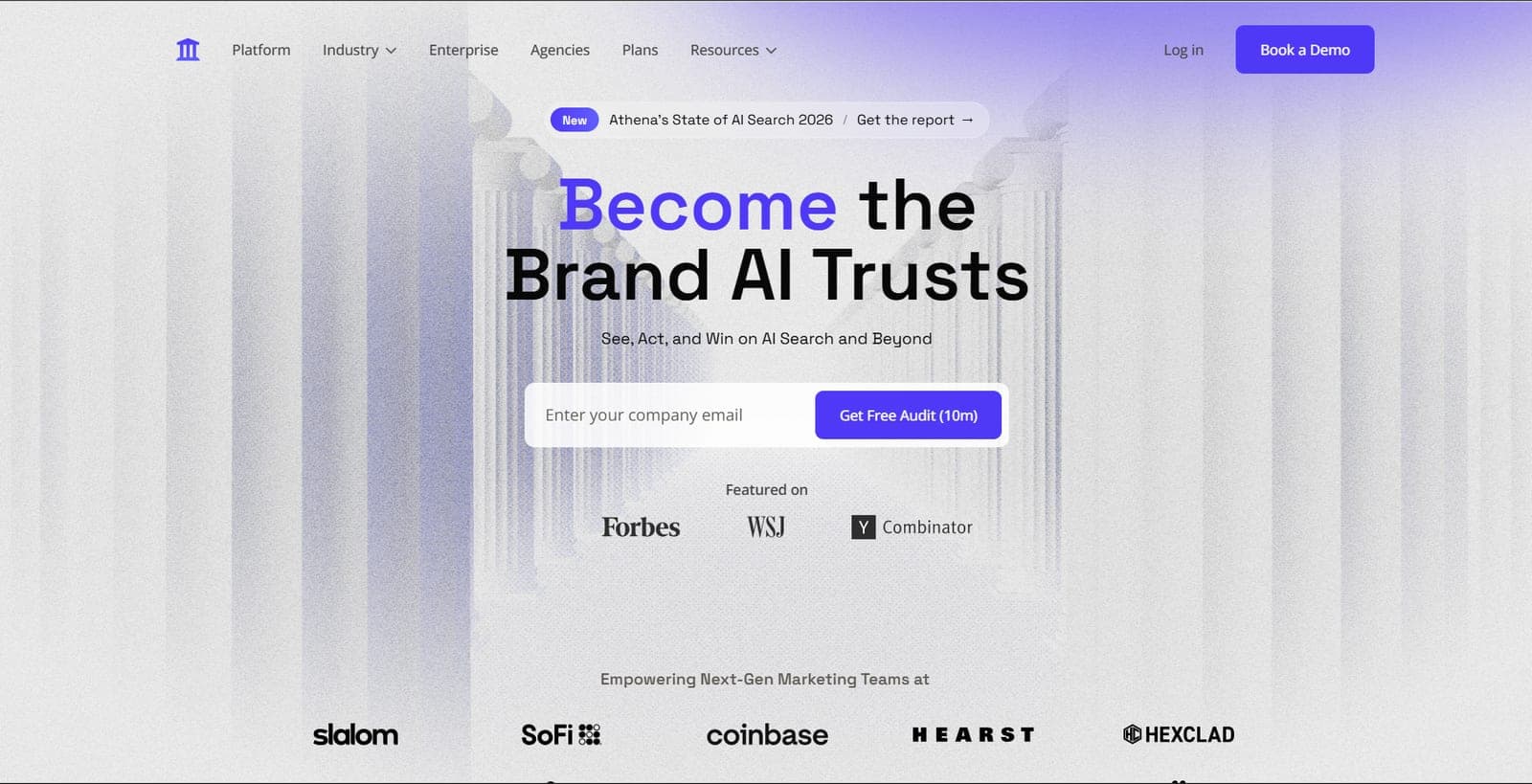
"Become the Brand AI Trusts". The free tier is real rather than a countdown trial, which makes AthenaHQ the natural first stop if you want to see the shape of this data before requesting budget.
Key features
- 5 engines free: ChatGPT, Perplexity, Google AI Overviews, Gemini and Copilot; Starter adds AI Mode, Claude, Grok, DeepSeek and Meta AI, for 10 models in total
- Citation source analysis and link building
- Brand mention tracking across those engines
- Metered by credit
Pros
- The only perpetual free tier verified in this set
- Five engines on the free tier, ChatGPT, Perplexity and Google AI Overviews included
- No credit card and no contract needed to see real data
Cons
- The free tier is credit-capped, so it is a sample rather than a running programme
- The step from free to $295/mo is steep with nothing in between
- Creator attribution and URL seeding are not stated
Pricing
- Essential: free, with $25 of credit (300 credits)
- Starter: $295/mo
- Enterprise: custom
Buy it when you need to see this data before you can justify a budget line. Watch out for the credit cap, which makes it a sample rather than continuous monitoring.
Scrunch: hardest to evaluate from the outside
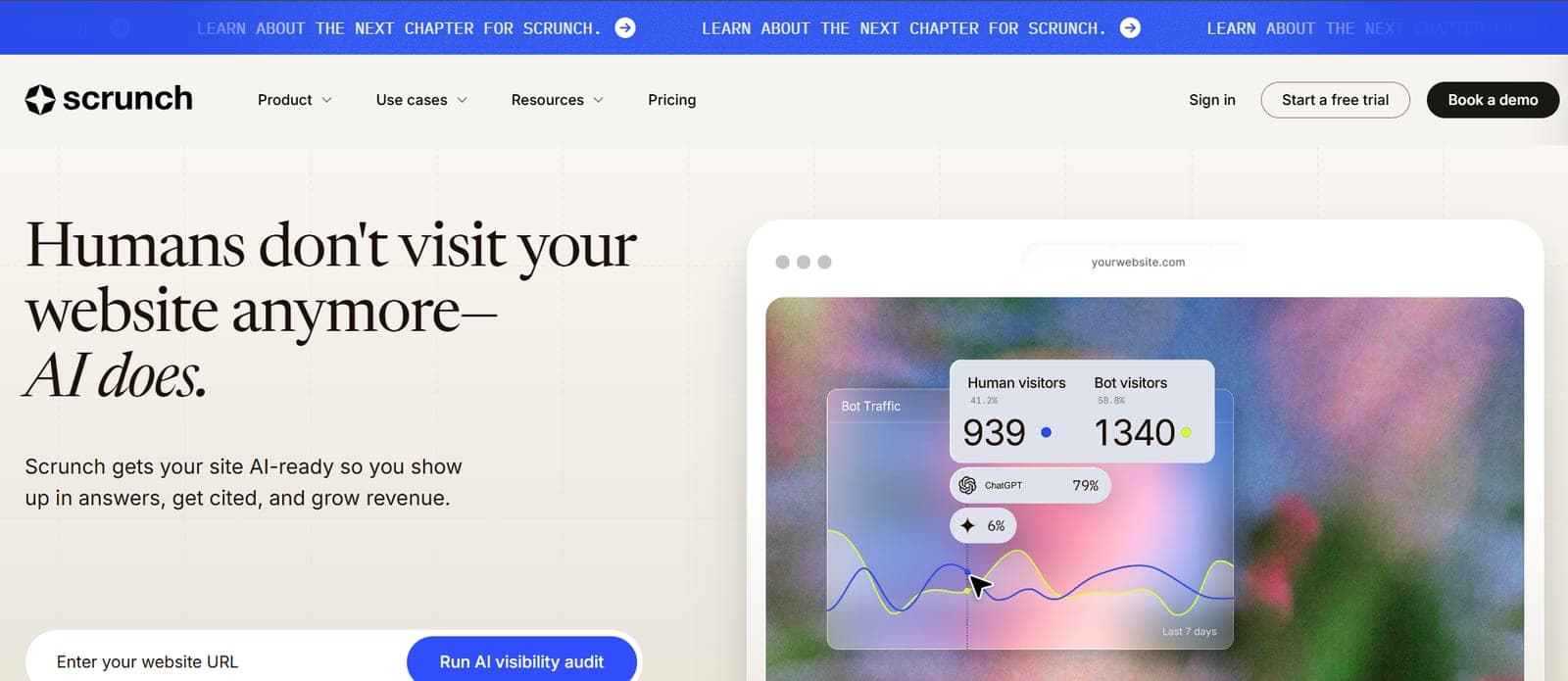
"Monitor and improve your brand's visibility in AI search". We are including it because buyers encounter it, and excluding it would make this list less useful, but there is less public information here than anywhere else in the suite tier.
Key features
- Five engines: ChatGPT, Perplexity, Claude, Gemini and Copilot
- Citation and source mapping, described as "which sites AI cites"
- 7-day free trial
Pros
- Five engines named explicitly
- A trial you can start without a sales call
Cons
- No pricing published on the homepage
- Whether its citation mapping separates owned from third-party domains is not stated
- Creator attribution and URL seeding are not stated
Pricing
- Not published on the homepage
- 7-day free trial
Buy it when the trial answers your questions, because that is the only way to evaluate it from outside. Watch out for the two unknowns: ask about price and about owned-versus-third-party scope on the call.
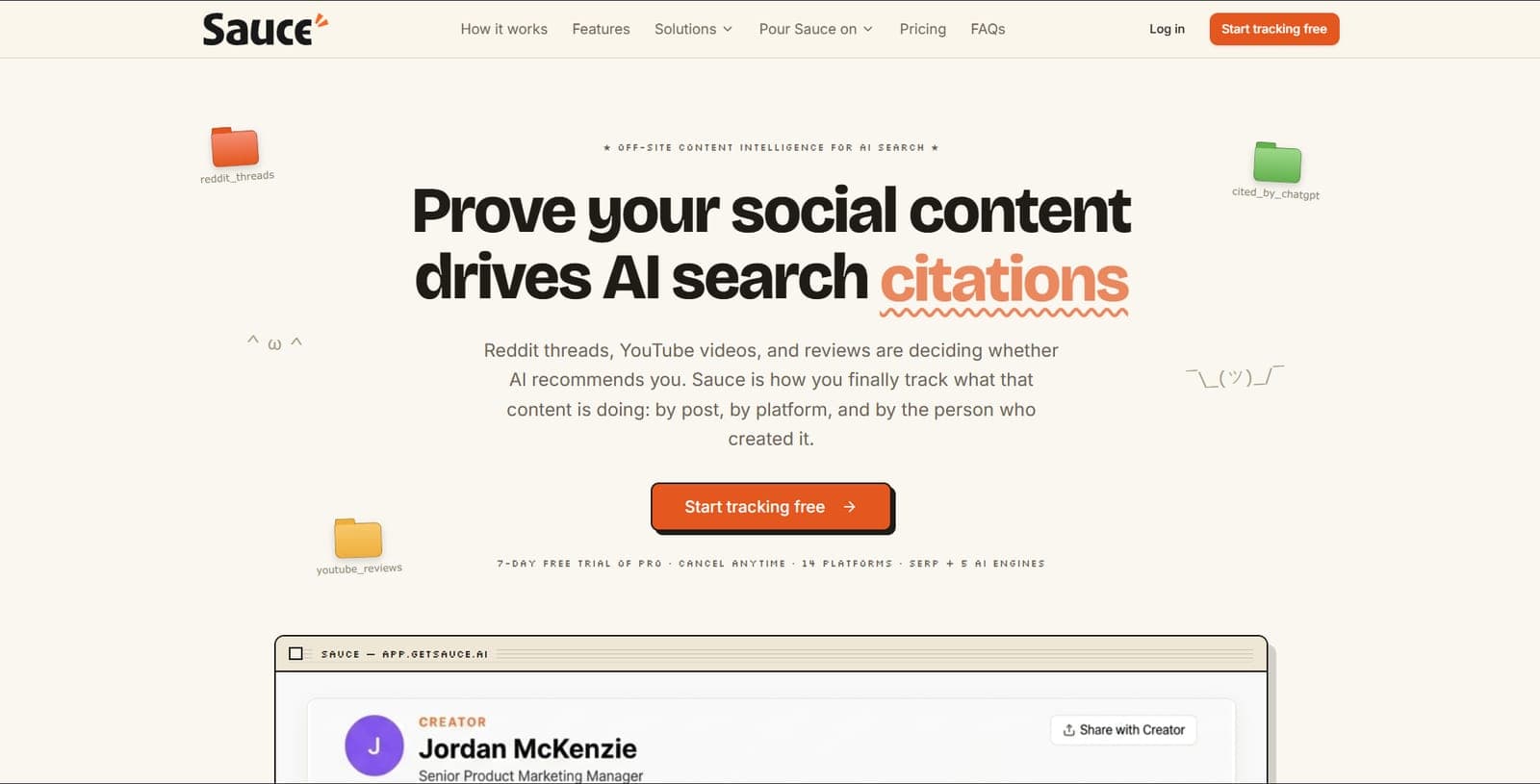
Sauce: the most featured off-site tool
Positioned as "Track How Your Off-Site Content Performs in AI Search", from Fan Out. It is the closest thing to a direct competitor for Plug, and on feature count it is ahead of us. The workflow mirrors ours: add your off-site content, map each piece to the person behind it, define your buyer queries, and run a check.
Key features
- 14 named platforms: Reddit, YouTube, LinkedIn, X, G2, Capterra, Software Advice, GetApp, TrustRadius, Trustpilot, Quora, Substack, beehiiv and Kit
- Creator attribution on every tier, including the $49 Starter
- Citation data broken down "by post, by person, by platform, and by engine"
- Search Console and analytics import, connecting citations to branded search lift and AI referral traffic
- Near-miss queries turned into ready-to-write content briefs, plus weekly digests
- Fan-out query variants and sales-call transcript upload on Pro and Team
- Creator leaderboards with movement, and multi-brand workspaces
Pros
- The fullest off-site toolkit in this list by a clear margin
- Creator attribution at the cheapest tier rather than gated upward
- The only tool here that connects citations to branded search lift
- Multi-brand workspaces, which matter if you run an agency
Cons
- 5 checks a month at Starter is a weekly spot check rather than monitoring
- ChatGPT is not included until the $99 Pro tier
- Unlimited checks do not start until $299/mo
- No free tier, only a 7-day Pro trial
Pricing
- Starter, $49/mo: 3 engines, 5 checks/month, 25 seed queries and 25 tracked URLs per cluster, 1 brand
- Pro, $99/mo: 6 engines adding ChatGPT, AI Mode and Bing Copilot, 15 checks/month, 50 seed queries per cluster, unlimited tracked URLs, up to 3 brands
- Team, $299/mo: unlimited checks, 100 seed queries per cluster, 5 brands, seats and roles
- Full-service agency programme from $10k/mo
- 7-day Pro trial, no free tier
Buy it when you want the fullest off-site toolkit and the reporting layer that connects citations to search lift, or when you manage several brands. Watch out for the check meter, and note that ChatGPT is not included until Pro.
One note in fairness to them: their features page and pricing page disagree about whether ChatGPT is included at Starter. We have used the pricing page, which says three engines.
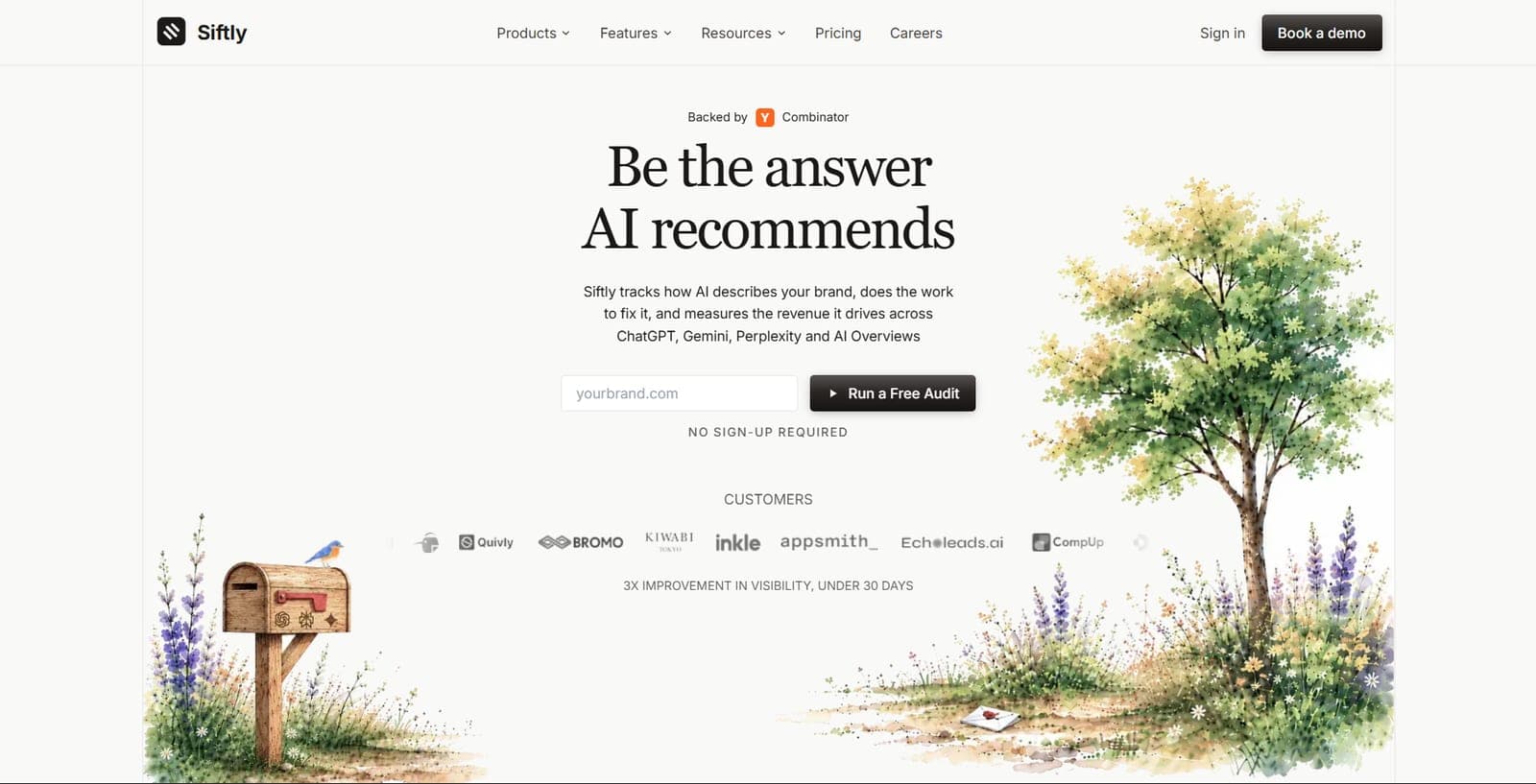
Siftly: the suite whose reporting model is closest to the off-site argument
"See which URLs get cited when AI platforms discuss your brand, competitors, and industry topics." The reason it earns a place here is one line of its own copy: "Every citation is classified by source: your own content, media coverage, social platforms, or competitor sites." That owned-versus-earned split is the taxonomy this whole category ought to use, and most suites do not report it.
Key features
- Four engines: ChatGPT, Claude, Perplexity and Google AI Overviews
- Every citation classified by source: your own content, media coverage, social platforms or competitor sites
- Free AI visibility audit
Pros
- Reports the owned-versus-earned split that most suites leave out
- A free audit before any commitment
Cons
- No pricing published on the citation-tracking page
- Classifying sources is not the same as letting you nominate which ones to watch
- Creator attribution and URL seeding are not stated
Pricing
- Not published on the citation-tracking page
- Free AI Visibility Audit offered
Buy it when you want to know what proportion of your citations come from pages you control versus pages you do not, without moving to a specialist tool. Watch out for the absence of published pricing.
VerseOdin: the upper price anchor
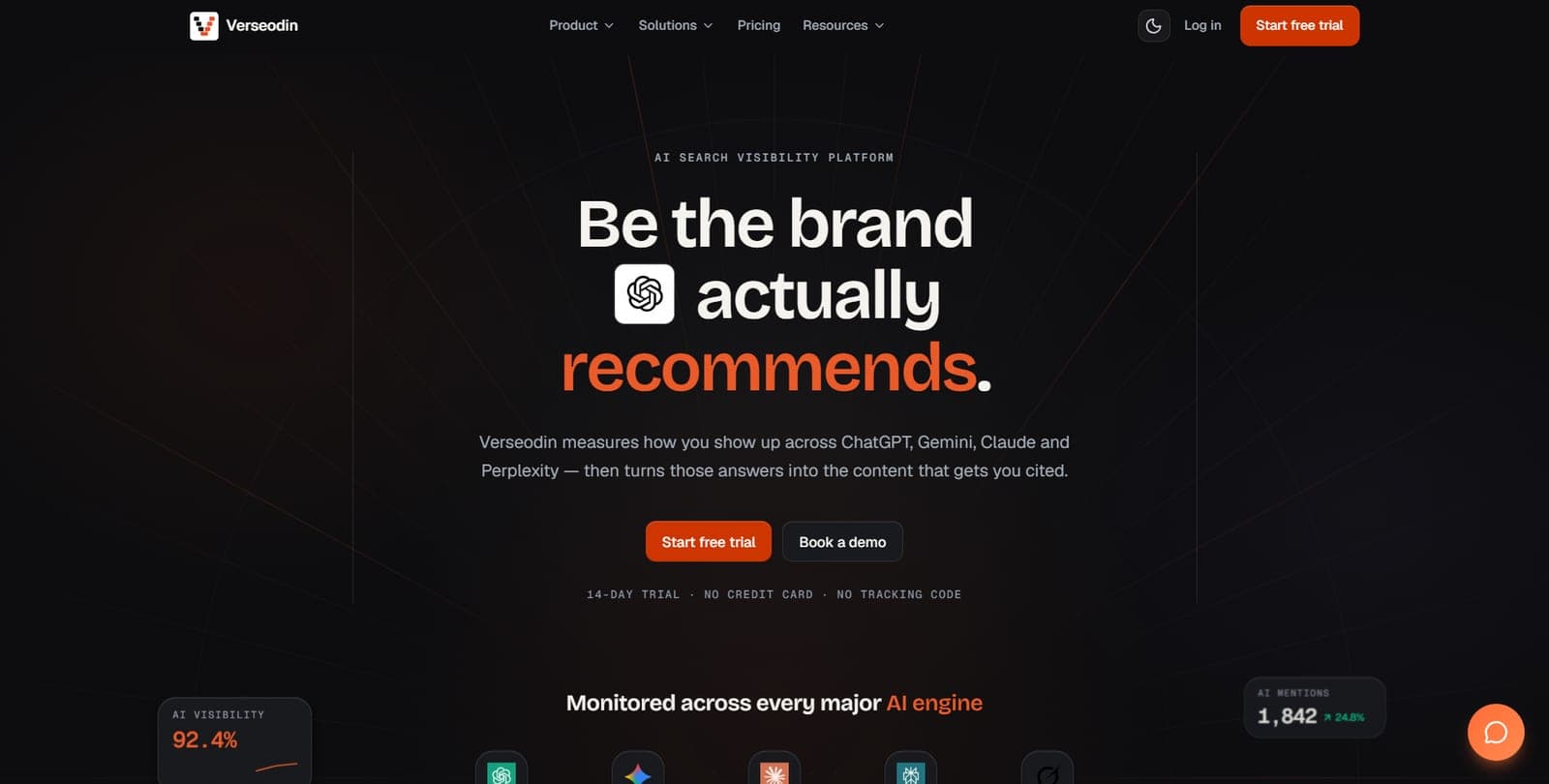
"Be the brand AI actually recommends". This is the highest published entry price we verified, by a distance, and it is useful as a reference point: it tells you the ceiling the market will currently bear for six-engine monitoring.
Key features
- Six engines: ChatGPT, Gemini, Claude, Perplexity, Grok and Copilot
- Starter Monitoring at a single published price with no engine gating stated
- 14-day trial requiring no credit card
Pros
- Six engines at the entry tier, with no tier gating stated
- A trial that needs no card
- A published price, which half this category does not offer
Cons
- $799/mo is the highest published entry price in this comparison
- Creator attribution and URL seeding are not stated
- We could not confirm the Reddit and social tracking that third-party coverage describes
Pricing
- Starter Monitoring, $799/mo, or $7,990 a year
- Enterprise, custom
- 14-day trial, no credit card
One caution. Third-party coverage describes a VerseOdin "Socials" section with Reddit prompt tracking. We could not confirm that on their own site, so we are not claiming it. If off-site coverage is why you are considering them, ask directly.
Pierview: thin from the outside
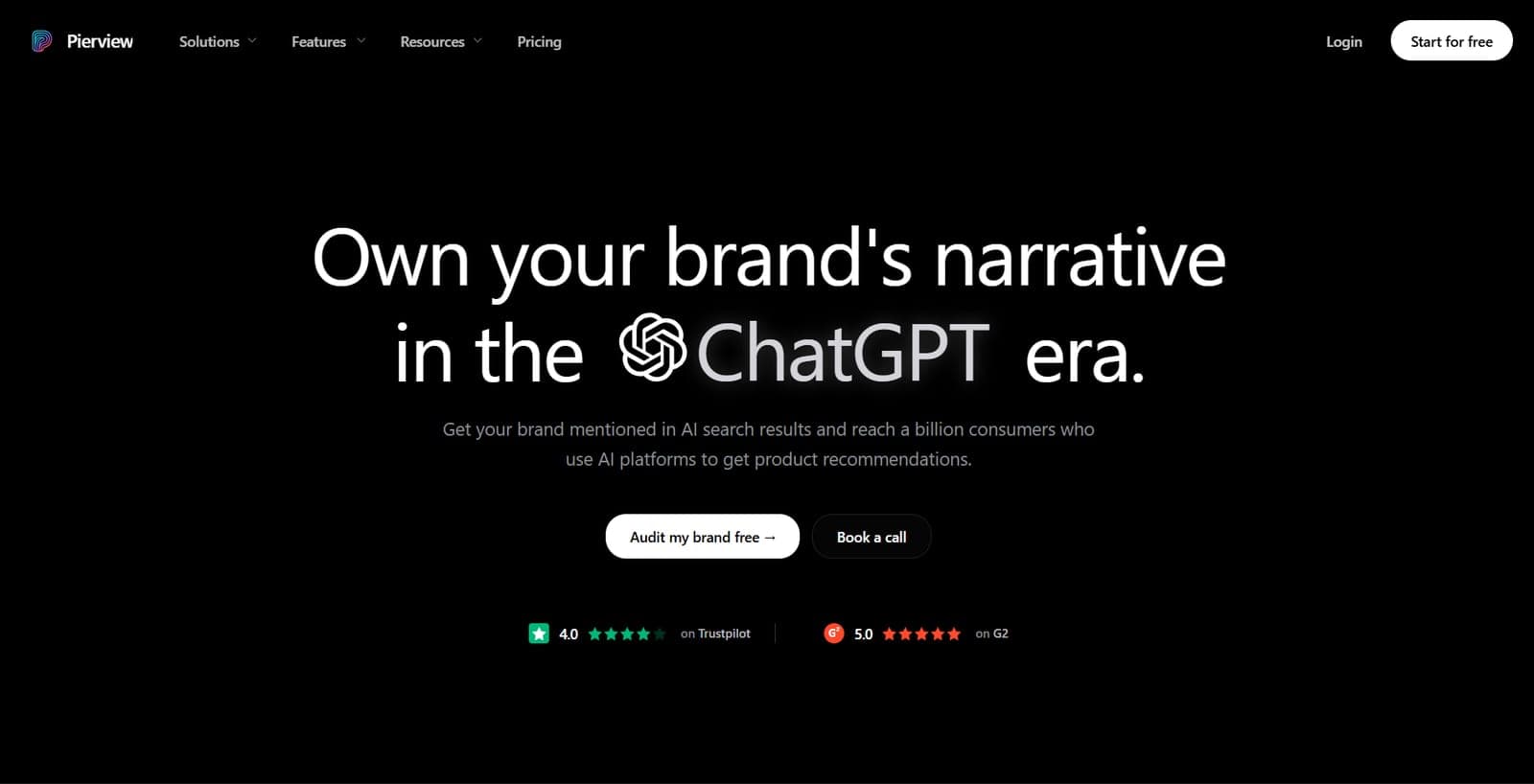
"Own your brand's narrative in the ChatGPT era". Included because buyers encounter it, but we should be straight about the limits of what we could verify from their public pages.
Key features
- A feature named Reddit Analyzer
- Free brand audit
- ChatGPT named explicitly; other coverage described only as "leading LLMs"
Pros
- A free brand audit with no commitment
- Names Reddit specifically, which few suites do
Cons
- No engine list published, only "leading LLMs"
- No pricing published on the homepage
- Whether the Reddit Analyzer covers threads you do not own is not stated
Pricing
- Not published on the homepage
- Free brand audit offered
Buy it when the free audit tells you something useful. Watch out for the two open questions: which engines, and whether Reddit Analyzer reaches threads you do not own.
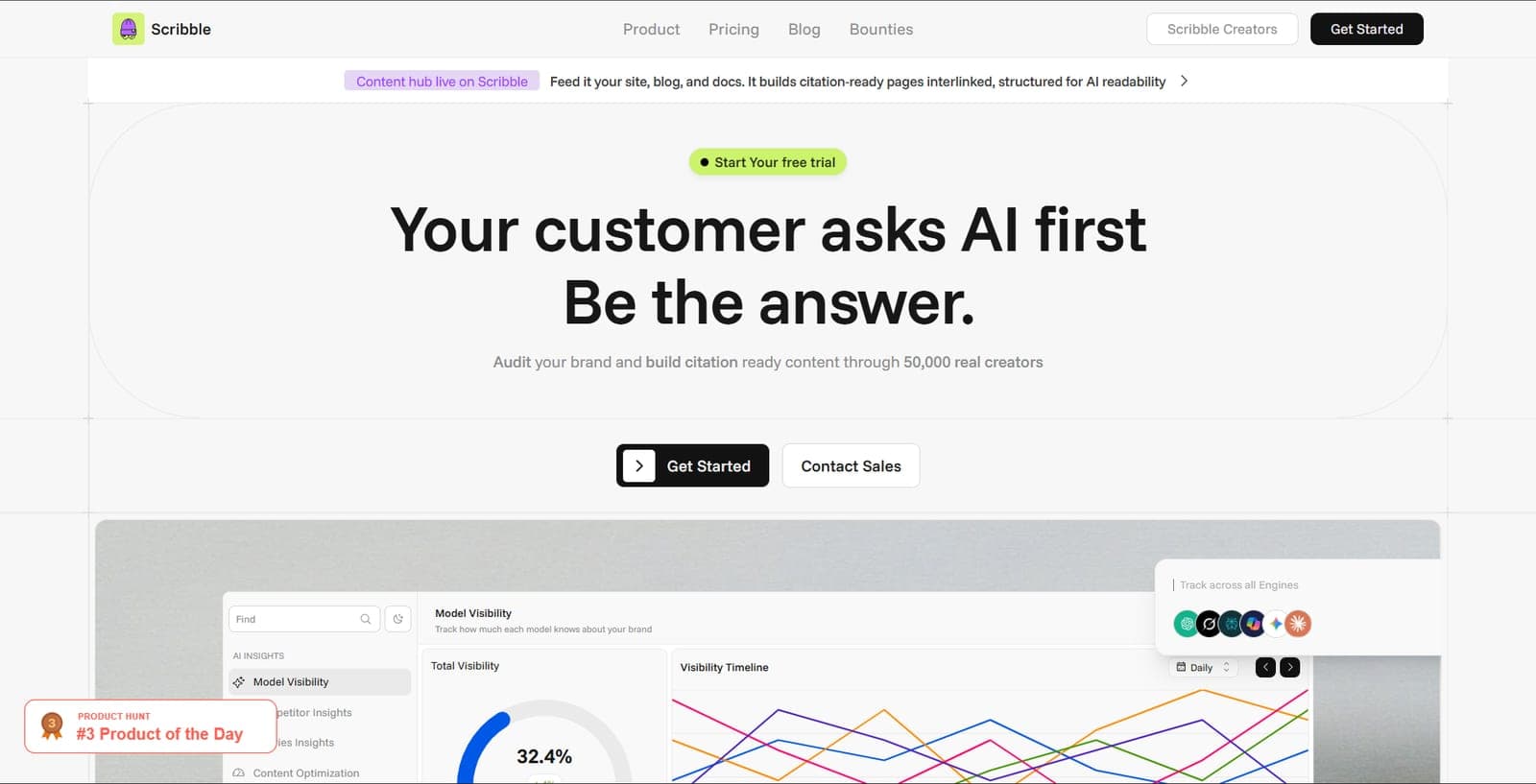
Scribble Network: not a tool so much as a programme
Positioned as "Monitoring and building AI Visibility", tagline "Audit. Create. Amplify." It belongs on this list because it does track citations and attribute them to creators. But it is a different purchase from everything else here, and treating it as a like-for-like alternative would mislead you: Sauce and Plug measure content you or your creators already produce, while Scribble produces the content.
Key features
- A network of 50,000 creators; your citation gaps become bounty briefs they compete to fill
- Payouts tied to citation performance rather than flat fees, with creators "scored by citation history, not followers"
- Per-creator citation counts by handle in the dashboard
- Five engines: ChatGPT, Gemini, Perplexity, Copilot and Grok, with Claude marked coming soon
- Eight publishing surfaces: X, Medium, Substack, Paragraph, Reddit, YouTube, Instagram and Quora
- Conversation Radar, competitor benchmarking, a content hub and a citation readiness score
Pros
- Solves creator supply, which no measurement tool on this list does
- Creator attribution shown per handle
- Payment tied to citation outcomes rather than to output volume
Cons
- A $1,500+/mo floor at the only tier whose price is published
- Basic and Insight prices were not published in a form we could verify
- Every customer named on their site is a Web3 or crypto brand
- Claude is not covered yet
Pricing
- Basic and Insight: prices not published in a form we could verify, so we are not quoting them
- Custom: $1,500+ per month, including managed campaigns and 20+ optimised content pieces a month
- Free trial offered
Buy it when you have budget and no creator supply: it solves the problem of not having anyone to write the off-site content in the first place. Watch out for the price floor, and ask for references in your category before assuming the creator network reaches your buyers.
Their claims of "6,000+ creator pieces cited" and a 20% citation-share case study are vendor figures we have not independently verified. Treat them as marketing, not evidence.
Plug: best for daily monitoring of commissioned placements at zero cost
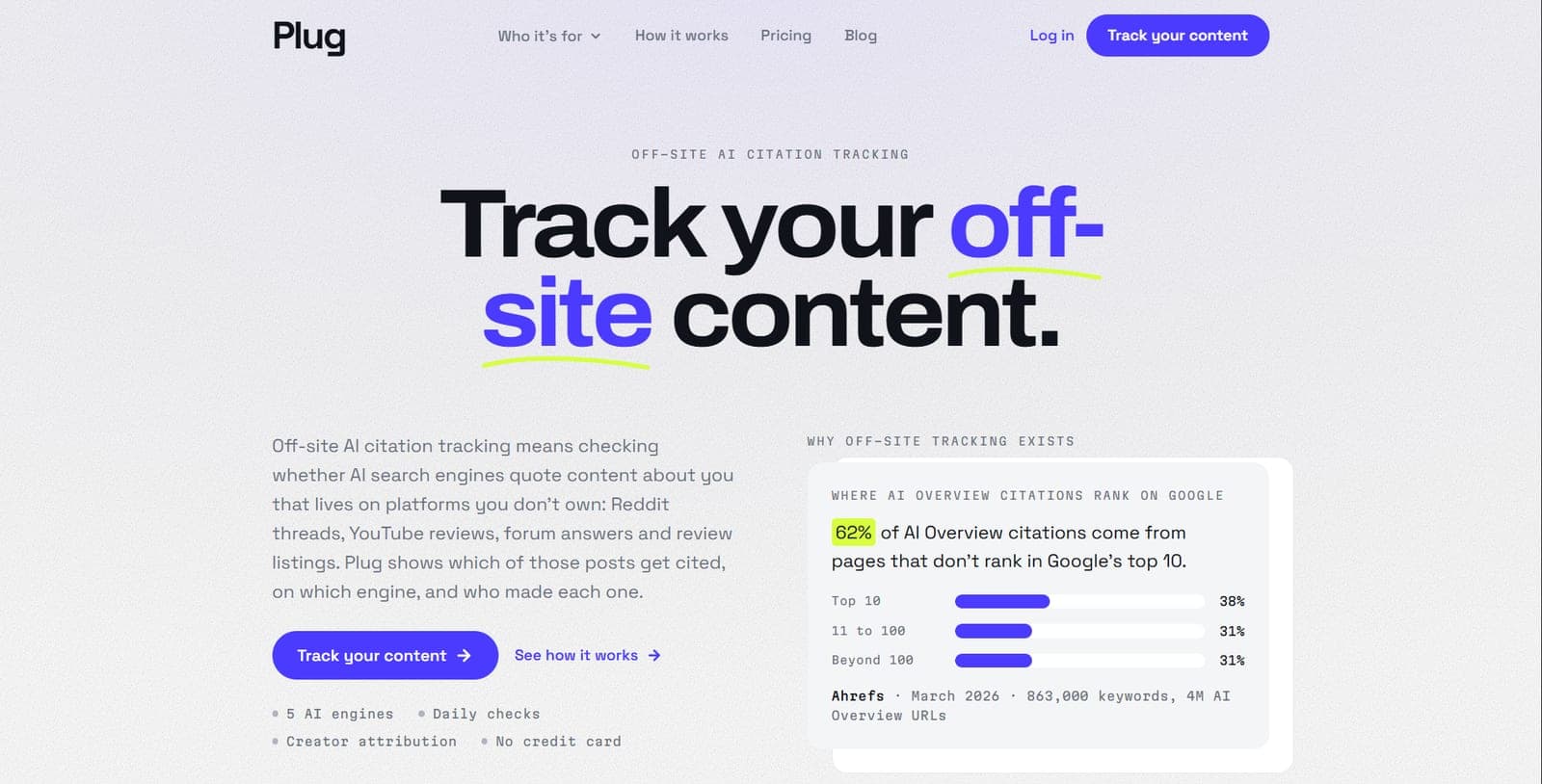
Disclosure again: this is ours. It is the most focused tool on the list, built for one job and tuned hard for it: daily, unmetered tracking of the specific off-site placements you nominate, with the creator behind each one named. Same shape of workflow as Sauce, paste the off-site links you care about, tag the creator behind each, and enter your buyer questions, then see which placements got cited, on which engine, and who earned each one. The difference is the meter and the frequency: Plug runs every day against as many buyer queries as you want to throw at it, with no prompt, credit or check limit, at $0 during early access.
Key features
- Three engines: ChatGPT, Google AI Overviews and AI Mode
- Daily checks
- Unlimited tracked posts and unlimited buyer queries
- Creator attribution on every post you nominate
- Trend tracking and drop alerts
- Stakeholder reports and CSV export
Pros
- Daily checks against unlimited queries, the highest frequency in this comparison
- ChatGPT included at the entry tier rather than gated upward
- No meter of any kind: no prompt, credit or check limits
- No credit card required
Cons
- Only three engines: ChatGPT, Google AI Overviews and AI Mode
- No Perplexity, Copilot, Claude, Gemini or Grok coverage
- No Search Console import, content briefs, leaderboards or multi-brand workspaces, all of which Sauce has
- The $0 is an early-access period, not a permanent tier, and no end date is set
Pricing
- Early access: $0, with unlimited tracked posts, unlimited buyer queries and daily checks
- Will convert to paid on a date we have not announced
- Our pricing page commits to notice before anything changes
Applying this post's own test to ourselves, since it would be a poor guide that did not: the chart above measures whether a vendor gates engines behind a higher tier, and Plug does not, which is why its row shows no gap. Everything it tracks, it tracks at the $0 tier. The number to weigh is the coverage itself: three engines, ChatGPT, Google AI Overviews and AI Mode, with no Perplexity, Copilot, Claude, Gemini or Grok.
Buy it when you are measuring an off-site programme and want to know, every day and across every buyer question you have, which placement and which creator earned each citation, without a meter deciding how much you get to look. That is the case Plug is built for, and nothing else on this list does it daily at $0. Do not buy it if you need Perplexity, Copilot, Claude, Gemini or Grok, which Plug does not cover. And do not build a two-year budget on the $0.
What is creator attribution, and which tools have it?
The useful way to read this list is not by price. It is by what a citation gets attributed to.
Attributing a citation to a specific named creator is not stated on the public pages of Profound, Peec AI, Otterly.ai, AthenaHQ or Scrunch as of 18 August 2026. Those five attribute to sources: a domain, or a page. Sauce, Scribble Network and Plug attribute to people, and the first and third also let you nominate the content to watch rather than only discovering it.
That distinction sounds small until you own a budget. If you paid four creators and briefed six more, "reddit.com earned 22 citations" does not tell you who to pay again. "This creator's three posts earned 14 citations across ChatGPT and Perplexity, and this creator's earned none" does. It converts an off-site programme from a spend into a performance line, which is the argument in briefing creators for citations, not impressions.
So the decision collapses to two questions. Do you need creator attribution at all? If not, pick from the suites on engine coverage and price and ignore this whole section. If you do, the follow-up is whether you have creators. If you already work with them, Sauce and Plug measure what they produce, and the split is that Sauce has more features while Plug checks more often for less: five checks a month at $49 against daily at $0. If you have no creator supply, Scribble sells you the network as well as the dashboard, at a materially higher floor.
A caution on our own framing here. We have twice told readers a confident number about who does creator attribution, and been wrong twice: first "only Plug", then "only Sauce and Plug". This is a young category and the vendors doing this are exactly the ones least likely to rank for generic tool queries. So the claim above is deliberately the narrow one: those five suites do not describe it on their public pages. Treat any list of who does as provisional, including ours.
We are describing what these vendors publish, not auditing their products. If one of the five ships creator attribution after this date, this section is what we will rewrite first.
Three questions that separate these tools faster than a demo
1. At the price I would actually pay, how many engines do I get? Not the homepage number. The tier number. This single question reorders the list: Profound goes from widest coverage to one engine, and Otterly's four becomes the honest baseline. Engines are not interchangeable either. Across 602 prompts and 21,143 citations, ChatGPT cited a mean of 6.88 sources per prompt, Google AI Overviews 12.06 and Perplexity 16.35, so which engines you track changes what your numbers mean.
2. What does the meter count, and what happens when I hit it? Three different meters are in play here and they are not comparable. Prompts (Profound, Otterly) price your curiosity: if a hundred buyer questions costs $189/mo and two hundred costs $489/mo, your query list quietly shrinks to fit the plan, and the questions you drop are the ones you never learn the answer to. Credits (AthenaHQ) price your looks. Checks (Sauce) price your frequency, which is the one people misjudge: five checks a month is a weekly spot check, not monitoring. Ask what happens at the limit, and whether it is a hard stop or an overage.
3. Can I tell it what to watch? Discovery answers "what is happening". Seeding answers "did the thing I paid for work". Most teams eventually need both, and only the off-site tools describe seeding.
The tools that write the posts instead of measuring them
A category you will meet while shopping and should not confuse with this list.
RedditMaster describes itself as "an autonomous reddit seo agent... that wins the threads ChatGPT cites and Google ranks." It finds relevant threads, writes replies in your voice, and doubles down on what lands. Others in this lane include Replymer ("get recommended on Reddit & X on autopilot") and Scaloom.
These are activation tools. They create off-site presence; everything else on this page measures it. Comparing them to a citation tracker is comparing a printing press to a ruler, and a buyer who conflates them ends up with either content nobody is measuring or measurement of content nobody is producing.
Two cautions if you go this way. First, we have not verified these products against their own pricing pages, so treat the descriptions above as positioning rather than fact. Second, autonomous posting on Reddit carries real moderation risk: in a 90-day programme, disclosed expert comments survived at 83% against 18% for undisclosed promotion. An agent posting in your voice at scale is on the wrong side of that ratio unless disclosure is built in. The playbook is in how to get cited on Reddit by ChatGPT.
What none of these tools do
Worth saying, because the category oversells itself and a bad expectation produces a bad quarter.
None of them report traffic from a citation. A citation frequently produces no click. Report presence in the answer, not sessions, and never forecast traffic from citation counts. The reporting conventions are in how to report off-site AI citations to stakeholders.
None of them make you get cited. They measure. The work that earns citations is off-site: Reddit is the single most-cited domain in AI answers, and domains with active G2 or Capterra profiles show roughly three times higher citation probability. No dashboard writes that post for you.
None of them are rank trackers, and you should stop treating them as one. Only 38% of the pages cited in Google's AI Overviews also rank in its top 10, down from 76% eight months earlier. Position stopped predicting citation. That gap is the reason this category exists, and it is covered in what off-site GEO is.
How to shortlist in twenty minutes
- Write your buyer questions first. Ten to fifty real queries. This number decides your tier on every metered tool, so it decides your budget before any vendor does.
- List the engines that matter to your buyers, then check each vendor's price at that engine count, not their maximum.
- Decide whether you need creator attribution. If you pay or brief creators, that narrows you to Sauce, Scribble Network or Plug immediately and the suites stop being relevant. If you do not, ignore this axis entirely and buy on coverage and price.
- Work out your frequency. Daily, weekly, monthly. This is the axis buyers forget, and it is where the off-site tools differ most sharply from each other.
- Start on the $0 entry points. AthenaHQ's free tier is perpetual but credit-capped; Plug is unlimited but only for the duration of early access, which has no published end date. Sauce, Scrunch, Profound, Peec AI and Otterly offer trials. Any of them will show you real data before you write a business case, but only AthenaHQ's survives a budget cycle unchanged.
- Re-check prices before you sign. Ours are stamped 18 August 2026 and this category moves monthly.
Corrections and updates
Every price and feature claim here was verified against the vendor's own live pages on 18 August 2026 and carries that date. If you work at one of these companies and something is wrong or out of date, tell us and we will correct it and note the change. That offer is the reason the date stamp is on the images as well as in the text: when the prices move, this page is wrong, and you should be able to tell at a glance how old it is.