Yes, and far more than any other video platform. YouTube is cited roughly 200 times more often than Vimeo, TikTok or Twitch in AI search, and it appears in about 29.5% of Google AI Overviews, where it is the most-cited domain overall. AI doesn't watch the video, though. It reads the transcript, description and chapters, which is why a well-captioned review can get quoted while a silent demo can't.
Most teams treat YouTube as a reach channel: views, watch time, subscribers. But the buyer who used to watch your review now reads an AI answer that quoted it, often without pressing play. This post covers how often AI actually cites YouTube, why it beats every other video platform, the transcript mechanic that decides which videos get pulled, and what to do so yours are the ones a model lifts from.
Does AI actually cite YouTube videos?
Yes, heavily, and the gap over other video platforms isn't close. BrightEdge analysed citation patterns across Google AI Overviews, Google AI Mode, ChatGPT and Perplexity from May 2024 to September 2025 and found YouTube cited roughly 200 times more than any other video platform. Its nearest rivals barely register: Vimeo at 0.1%, TikTok at 0.1%, Dailymotion and Twitch rounding to zero. Inside Google AI Overviews, YouTube appears in 29.5% of answers, the top domain overall, ahead of Mayo Clinic at 12.5%.
It isn't only a Google phenomenon. In Peec AI's analysis of 30 million cited sources across ChatGPT, Google AI Mode, Gemini, Perplexity and AI Overviews, YouTube ranked as the second most-cited domain overall, behind Reddit and ahead of LinkedIn, Wikipedia and Forbes. So depending on which study you take, YouTube is either the most-cited domain in Google's answers or the second most-cited across the whole web as far as AI is concerned. Either way it is the only video source that registers at all. For the full source mix, see where AI actually gets its answers.
Why YouTube dominates and TikTok doesn't
Because AI reads text, not video, and YouTube is the video platform that ships the most text. A retrieval engine can't watch a clip. It ingests the transcript, title, description and chapter markers, then quotes from those. YouTube auto-generates captions on nearly every upload and exposes long descriptions and timestamps, so a ten-minute review becomes a few thousand words of clean, attributable, machine-readable copy. Structurally, that is closer to an article than to a video.
TikTok, Reels and Shorts are short, caption-light and built to be watched rather than read, so there is little retrievable text to quote. Peec AI's researchers put the mechanic plainly: YouTube dominates video citations via transcripts and descriptions.
The lesson is uncomfortable for anyone who has poured budget into production value. View counts and cinematography are close to irrelevant to whether an AI quotes you. What matters is whether the words in your video exist as retrievable text. A polished demo with no spoken narration and an empty description is, to a model, a blank page.
Which videos get cited, and on which engines
Not evenly, and the pattern is useful. BrightEdge found YouTube citations cluster around tutorials and how-to content in finance, software and medical topics, plus pricing, deal-hunting, product demos and reviews. They show up far less for career advice, strategy or abstract concepts, where an article or a Wikipedia entry answers better. AI reaches for a video when the question is procedural or evaluative: how do I set this up, what does it actually cost, is it any good.
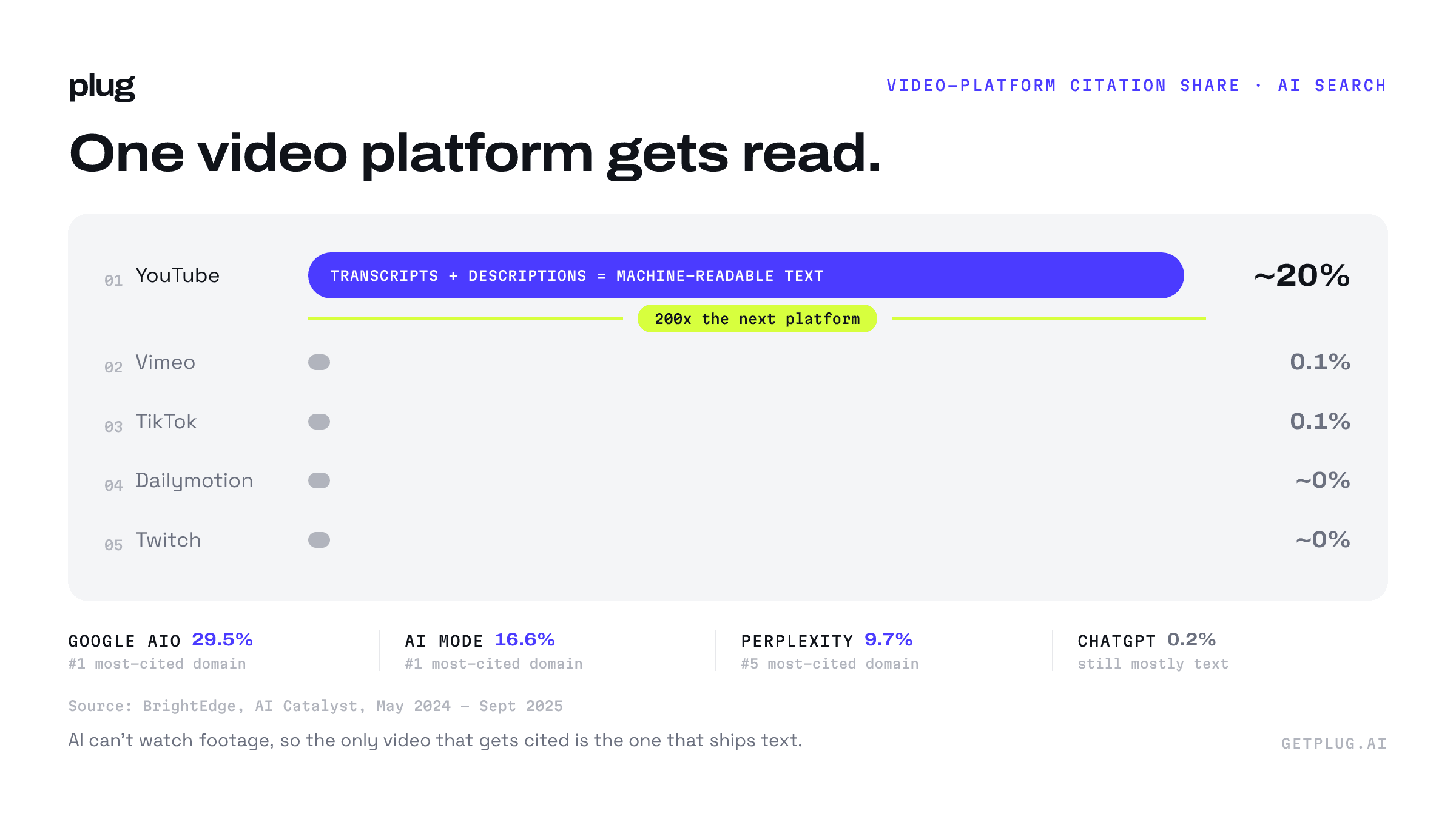
The engines disagree sharply on how much they lean on it, which matters if you're deciding where to compete. Per BrightEdge: Google AI Overviews cite YouTube in 29.5% of answers, its number one domain; Google AI Mode 16.6%, also number one; Perplexity 9.7%, its fifth; and ChatGPT just 0.2%, though growing. So a product-review video is close to mandatory for Google's surfaces, a solid bet on Perplexity, and barely moves ChatGPT, which still lifts more from text. For the per-engine logic behind those splits, see how Google AI Overviews and AI Mode pick sources and how Perplexity decides what to cite.
How AI reads a video: the transcript is the real page
Here is the reframe worth keeping. Your video's transcript, not its footage, is the document AI ranks and quotes. When an engine fans a question into sub-queries and goes looking, your YouTube page competes as text against blog posts and review listings, and it wins the same way they do. Which means the format rules that lift any page apply to your video's words.
Density of concrete detail is the big one. In the Princeton and IIT Delhi GEO study at KDD 2024, adding quotations lifted a page's visibility in generative answers by 42.6%, statistics by 32.8% and cited sources by 27.7% across 10,000 queries. A review that says out loud "it starts at $29 a month, onboarding took six minutes, and the rate limit is 100 calls a second" hands the model quotable, attributable facts. A review that says "it's really easy to use and we love it" hands it nothing.
Position matters too. Around 44% of AI citations are lifted from the first 30% of a document, which for a video means front-loading the answer in your first spoken minute and your description's opening lines rather than burying it after a two-minute intro.
The catch: a citation you can't see in YouTube Analytics
This is the part most teams miss, and it is why this sits in off-site territory. When an AI quotes your video, the buyer often never clicks. YouTube Analytics shows views, watch time and traffic sources. It does not show you that ChatGPT summarised your pricing walkthrough, or that an AI Overview named your product using a line from a creator's review of you. The influence moved upstream of the play button, onto a page you can influence but don't fully control.
The numbers make the blind spot concrete. Only 38% of the pages cited in Google's AI Overviews also rank in its top 10, down from 76% eight months earlier, and YouTube is heavily represented in what's left: among AI Overview citations that didn't rank in Google's top 100 at all for the same keyword, 18.2% were YouTube URLs. A video that gets quoted daily can look mediocre in your dashboard while quietly shaping every AI answer about your category. Measuring that means watching citations rather than views, the premise behind AI Share of Voice, off-site.
How to get your YouTube videos cited by AI
Treat the video like a page you're trying to get quoted, because to a model that is exactly what it is. Five moves, in order of leverage.
- Write the transcript on purpose. Don't rely on raw auto-captions full of filler and misheard product names. Speak in clean declarative sentences, say your product and competitor names out loud, and upload a corrected transcript. The transcript is the page, so edit it like one.
- Front-load the answer. State the price, the verdict or the step in the first spoken minute and in the opening lines of your description. With 44% of citations coming from the first third of a document, a five-minute preamble buries the exact sentence you want quoted.
- Pack in specifics. Concrete numbers, prices, specs and named comparisons are what AI lifts and attributes. Adjectives are not. Say the figures aloud so they land in the transcript.
- Use chapters and a full description. Timestamped chapters and a detailed description give the model structured, sectioned text it can map to sub-queries, the video equivalent of clean headings. Target the procedural and evaluative queries YouTube already wins: how to set up X, X pricing, X review.
- Track what AI quotes, not what YouTube counts. Run your buyer queries in ChatGPT, Perplexity, AI Overviews and AI Mode, note which videos get cited about your category, yours or a creator's, and check whether the quoted detail is right. Then fix the transcript feeding the wrong line. For how the biggest engines assemble those answers, see how ChatGPT chooses which sources to cite.
Why your AEO dashboard misses YouTube citations entirely
Because your AEO tool watches your domain, and a YouTube citation is by definition not on your domain. It can confirm Google indexed your blog. It cannot tell you an AI Mode answer for "best CRM for small teams" quoted a creator's YouTube review of you, or of your competitor, because that decision was made on a video page your analytics never scans.
If YouTube sits in nearly a third of AI Overviews, and 18.2% of citations that rank nowhere in Google's top 100 are YouTube URLs, then a meaningful share of the answers shaping your reputation are built from videos your dashboards can't see. Closing that means running your buyer queries across the engines on a schedule, logging every cited URL, and separating your domain from the third-party pages doing the real work. That is the gap behind what off-site GEO is and why your AEO tool can't see it. Review listings are the sibling surface and follow the same rules, covered in how AI reads your G2 and Capterra listings.
Where this leaves you
YouTube is the one video platform AI trusts, and it trusts it because the platform hands over clean, machine-readable text: a transcript that competes as a document, not a clip that competes as a video.
So the move is twofold. Make your videos' words accurate, front-loaded and specific enough to be the source a model reaches for, and measure them by citation rather than by view, because the buyer may never press play.