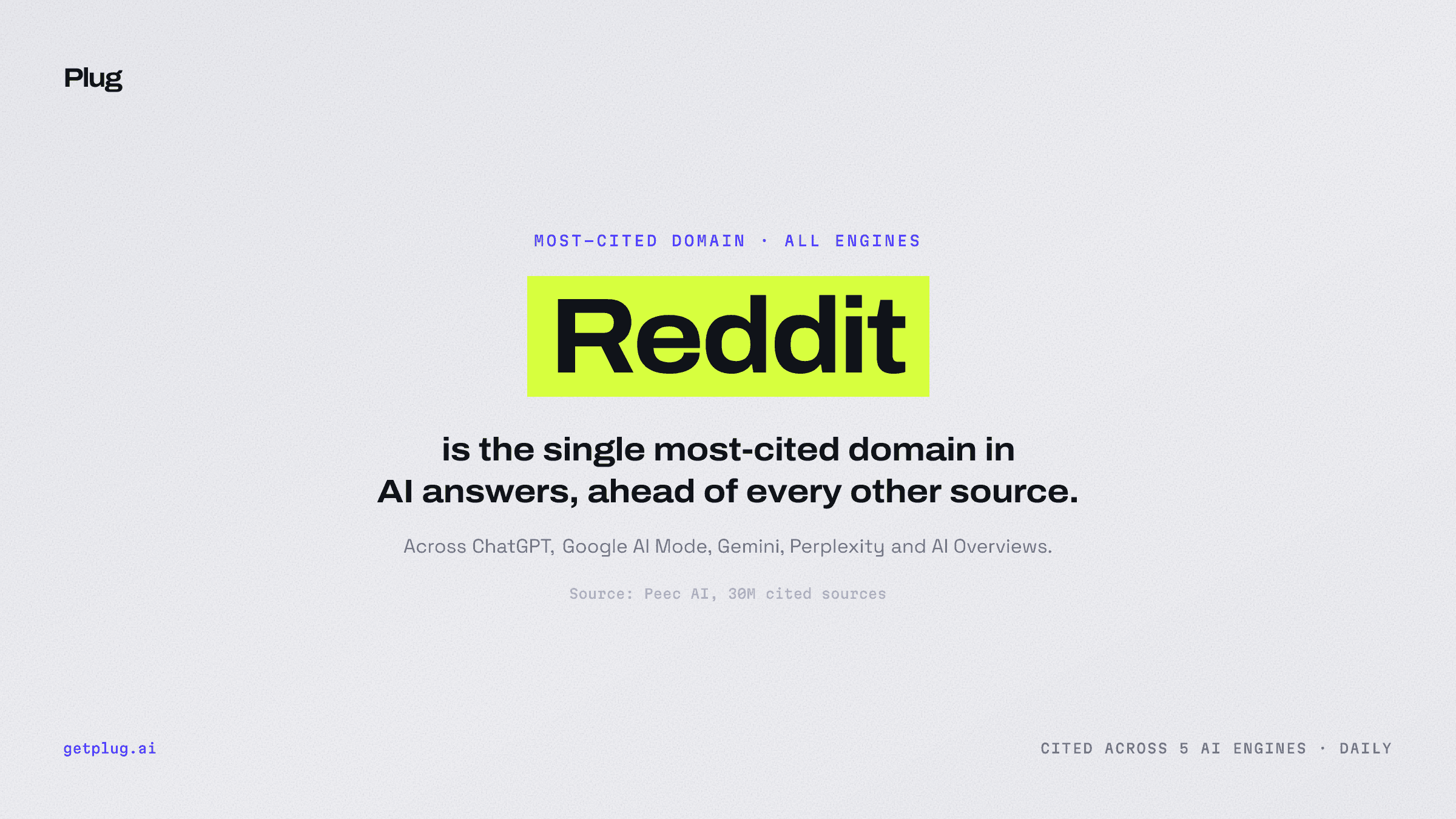
AI answers are assembled mostly from third-party, off-site content, not from brand websites. Across the major engines in 2026, Reddit is the single most-cited source, followed by Wikipedia and YouTube. Only about 38% of the pages cited in Google's AI Overviews also rank in its top 10, down from 76% eight months earlier, so the pages that decide your AI visibility are increasingly ones you don't own.
That reshapes where visibility work actually happens. If you want to understand why an engine names a competitor and not you, the answer usually isn't on your website. It's in the sources below. This guide breaks down the most-cited off-site sources in 2026, how each engine leans differently, and what it means for the content you produce.
How AI assembles an answer
AI search is retrieval-based: the engine reads your question, pulls a set of live documents, ranks them, and quotes the ones it trusts most. It favours independent, third-party sources over a brand's own copy, because outside validation reads as more credible than marketing.
This is why the source mix skews off-site. When someone asks an assistant “best project management tool for agencies,” the model retrieves forum threads, reviews, videos and Q&A pages, weighs them, and builds an answer from the most trustworthy. The strongest predictor of whether you show up isn't your backlink count. Branded web mentions correlate with AI citations at 0.656 to 0.709 depending on the engine, versus 0.218 for backlinks, which means the web's chatter about you carries roughly three times the weight of the links pointing at you.
The most-cited off-site sources in 2026
The most-cited sources are, in order, Reddit, Wikipedia and YouTube, followed by review sites, Q&A platforms and forums. These are consolidated findings from the largest citation studies of 2026, covering more than 680 million citations. The table below is the quick version.
| Source type | Why AI leans on it | What it's strongest for |
|---|---|---|
| Real opinions, high trust, huge coverage. The most-cited single domain | “Best X”, “is X any good”, honest comparisons | |
| Wikipedia | Structured, entity-clear, heavily referenced | Definitions, facts, entity grounding |
| YouTube | Demos and reviews with transcripts AI can read | How-to, product walkthroughs, reviews |
| Review sites (G2, Capterra, Trustpilot) | Structured ratings and verified opinions | Software shortlists, purchase decisions |
| Q&A and forums (Quora, niche forums) | Direct question-to-answer format | Long-tail and specific how-to queries |
| Named expertise and first-hand accounts | Thought leadership, professional context |
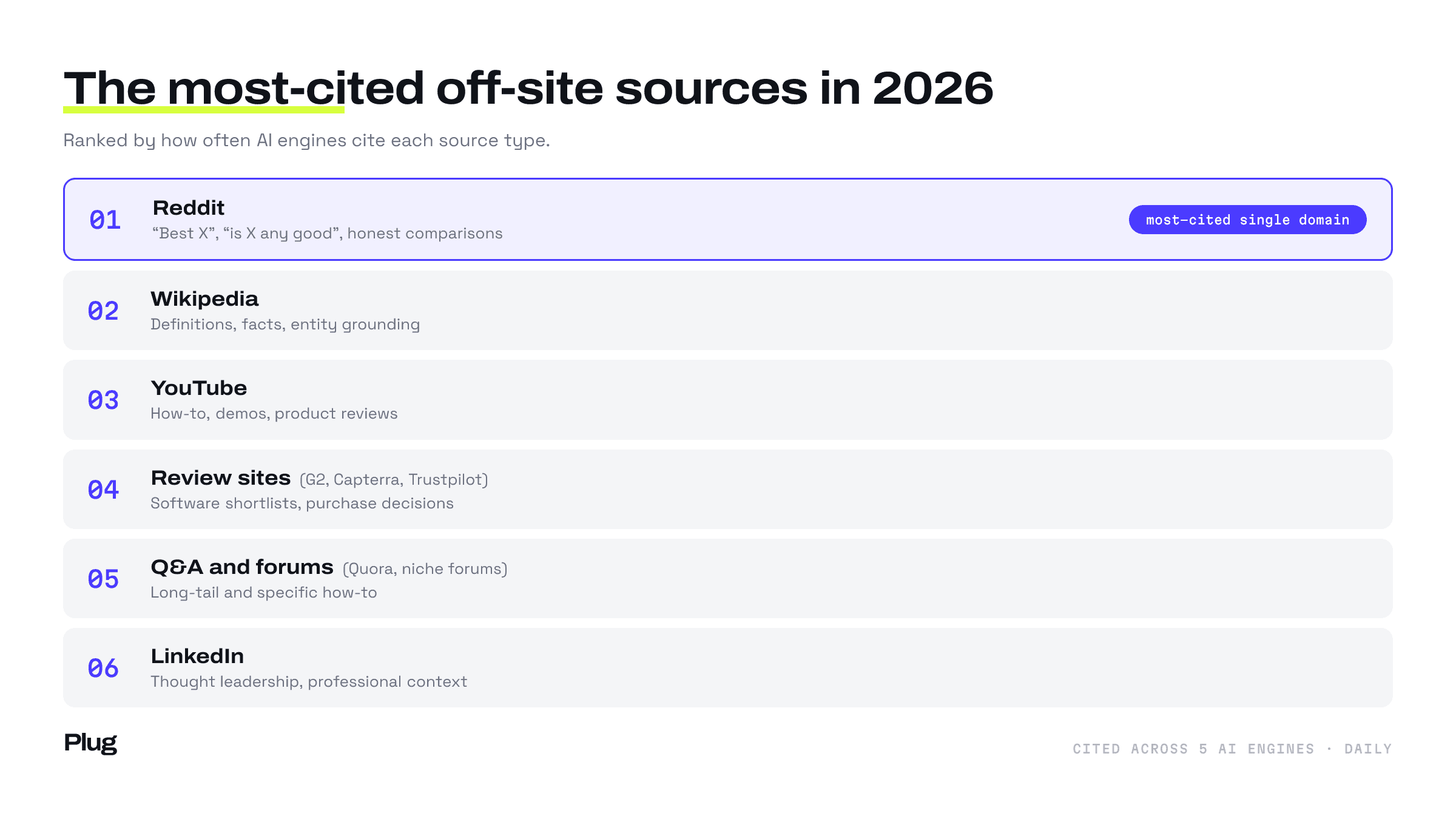
Notice what these have in common. Almost none of them are your domain, and all of them are places you can influence but not fully control.
Reddit is the number-one source
Reddit is the most-cited single domain across the major AI engines and, on Tinuiti's January 2026 numbers, accounts for 44% of the social-media citations inside Google AI Overviews. How hard each engine leans on it varies a lot, and moves fast: on Semrush's October 2025 tracking of 217,000 prompts, Reddit appears in 12.6% of SearchGPT answers, 9% of Google AI Mode responses and 3.5% of Perplexity's. Being the most-cited domain and being in most answers are different claims, and only the first holds.
Two things make Reddit hard to game and worth understanding. First, disclosure wins: engines can tell genuine community engagement from astroturfing, and manufactured posts get filtered out. Transparent participation is the only durable play. Second, it rewards patience. The average AI-cited Reddit post is around a year old, so a thread earns its citation slowly, as it accumulates upvotes and replies.
Wikipedia and YouTube
Wikipedia is the second most-cited source and YouTube is third. Wikipedia appears in a large share of ChatGPT's top answers because it is structured, entity-clear and densely referenced. YouTube earns citations because engines read video transcripts, and video mentions are the single strongest off-page predictor of AI citations measured.
Wikipedia's value is entity grounding: when an engine needs to confirm what your company is and what it does, a well-referenced entry settles it. YouTube's pull is different. YouTube mentions correlate with AI citations at 0.737, the strongest single off-page factor, because a product demo or review carries a transcript packed with the specific claims and comparisons an assistant can lift. A short explainer video often does more for AI visibility than another blog post.
Review sites, Q&A and forums
Review platforms like G2, Capterra and Trustpilot, plus Q&A sites like Quora and niche forums, make up the next tier of cited sources. They matter most for commercial queries, where an engine is effectively assembling a shortlist and wants structured, verified opinions to draw from.
These are the sources teams under-track the most. A single strong G2 listing or a well-answered Quora thread can be the reason your name appears in “best tools for X,” and yet neither shows up in a tool that only crawls your own domain. For a category like software, this tier often decides the buying-intent answers.
Each engine leans differently
The engines don't cite the same way. Perplexity is the most Reddit-heavy and the most sensitive to freshness because it retrieves live; ChatGPT cites fewer sources but quotes each more deeply; Google AI Overviews leans hard on Reddit, YouTube and Wikipedia. A post cited on one engine can be invisible on another.
| Engine | How it sources | Practical takeaway |
|---|---|---|
| ChatGPT | Cites ~7 sources but extracts ~4.2x more from each | Depth and a clean quotable passage beat breadth |
| Perplexity | Live retrieval, heavy on Reddit, favours recent content | Fresh, well-discussed threads move fastest here |
| Google AI Overviews | Reddit, YouTube and Wikipedia lead the source mix | Social and video proof matter as much as pages |
| Copilot / AI Mode | Blend of web index and partner sources | Broad, credible coverage carries over |
The practical consequence is that you cannot judge your AI visibility from a single engine, and you cannot judge it from your own analytics at all. The same query returns different sources on different engines, and shifts week to week. This is exactly why measuring citations, once per answer, per engine, per day, is most of the work.
What this means for your content
The takeaway is simple: most of what decides your AI visibility lives off your domain, so that is where the measurement and the effort belong. Your own pages still matter, but they are a minority of the sources an engine actually quotes.
In practice that means three things:
- Know which off-site placements already mention you. Most teams find threads, listings and videos they didn't know existed.
- Understand which engine favours which source, so you brief and seed accordingly.
- Track citations over time. A placement that gets quoted this month can quietly drop the next.
That off-site half is the part your dashboard was never built to show, and it is the half Plug tracks. For the full definition of the category, start with what off-site GEO is.