Google AI Overviews and AI Mode pick sources by query fan-out: they break your question into several parallel sub-queries, retrieve candidate passages for each from Google's live index, rank them, and synthesise the survivors into one answer with links. The unit that gets cited is the passage, not the page. Those passages lean heavily on third-party sources, with Reddit alone making up about 44% of AI Overviews' social citations.
Google's AI answers are the ones most people actually see. AI Overviews passed 2.5 billion monthly users and AI Mode passed one billion, both announced by Sundar Pichai on 19 May 2026. That scale makes them the highest-stakes engine to understand, and the one most likely to cite a page you don't own. This post covers how the fan-out works, which passages win, why Google reaches for Reddit and YouTube so often, and why the citations deciding your brand's answer are mostly off-site.
How AI Overviews and AI Mode choose sources
Query fan-out is Google's own term. When it launched AI Mode, Google described the technique as "breaking down your question into subtopics and issuing a multitude of queries" on the user's behalf. The system fires those sub-queries at its index in parallel, pulls candidate passages for each, and stitches the best of them into a single grounded answer with citations.
Two details are worth being precise about, because the internet is confident about things Google has not published.
What is documented: the fan-out itself, and that selection happens at the passage level, meaning Google surfaces the relevant *section* of a page for a given sub-query. AI Overviews and AI Mode are both grounded in Google's regular index and link to pages already eligible to appear in Search, so crawlability and clean, self-contained paragraphs are the price of entry.
What is inferred: the commonly quoted figure of 8 to 12 sub-queries per question, and the claim that Google fuses the ranked lists with Reciprocal Rank Fusion. Both are consistent across practitioner analyses and neither is confirmed by Google, which says only "a multitude". Treat them as a working model of the behaviour, not as published architecture. The model is useful precisely because it predicts what happens; it just isn't a spec.
Either way, the mechanic changes what ranking means. A page can be cited for one tight paragraph even if the rest of it is mediocre, and a page that ranks first in classic blue-link search can be skipped entirely if no single passage answers a sub-query directly.
Why Google leans on Reddit, YouTube and Wikipedia
Google leans on these because a fan-out system rewards sources that answer narrow sub-queries with independent, first-hand language, and forums, video transcripts and encyclopedic entries are dense with exactly that. Reddit is the standout: it accounted for about 44% of Google AI Overviews' social citations in early 2026, per Tinuiti's Q1 2026 study, against just 5% of Gemini's over the same period.
The tilt toward third-party pages is structural rather than a quirk. Retrieval-based engines treat an independent source as validation, what other people concluded, and weight it above your own marketing copy making the same claim. Across engines, Reddit is the single most-cited domain, with Wikipedia and YouTube close behind.
The scale of the off-site skew is easy to miss, and it is moving fast. Only 38% of the pages cited in Google's AI Overviews also rank in its top 10, down from 76% eight months earlier. So 62% of cited pages now sit outside the rankings most teams still track, up from 24%. The direction of travel matters more than the number. For the full cross-engine breakdown, where AI actually gets its answers lays it out.
What makes a passage win the fan-out
A passage wins when it answers one sub-query completely, on its own, with facts and named entities packed in. Vague, hedged or context-dependent paragraphs lose, because a passage that only makes sense in the surrounding article cannot be lifted into an answer without breaking.
Two levers are measurable. On density, the GEO: Generative Engine Optimization paper from Princeton and IIT Delhi, presented at KDD 2024, found that adding quotations lifted a page's visibility in generative answers by 42.6%, statistics by 32.8% and cited sources by 27.7% across 10,000 queries, while keyword stuffing hurt. On position, around 44% of AI citations are lifted from the first 30% of a document, which is the argument for putting a short direct answer immediately under each heading rather than building to it.
Authority compounds both, and it compounds off-site: domains with active G2 or Capterra profiles show roughly three times higher citation probability. That profile, dense and clearly attributed and self-contained and answer-first, describes a good Reddit answer or an editorial review as much as it describes your best page. Which is why those off-site passages so often out-cite your domain.
How Google differs from ChatGPT and Perplexity
AI Overviews and AI Mode share the same fan-out machinery but differ in depth. AI Overviews append a short synthesised answer above classic results; AI Mode is a conversational surface that follows up across turns and can fan out again on each one. Both differ from ChatGPT and Perplexity in being grounded directly in Google's Search index rather than a separate retrieval stack.
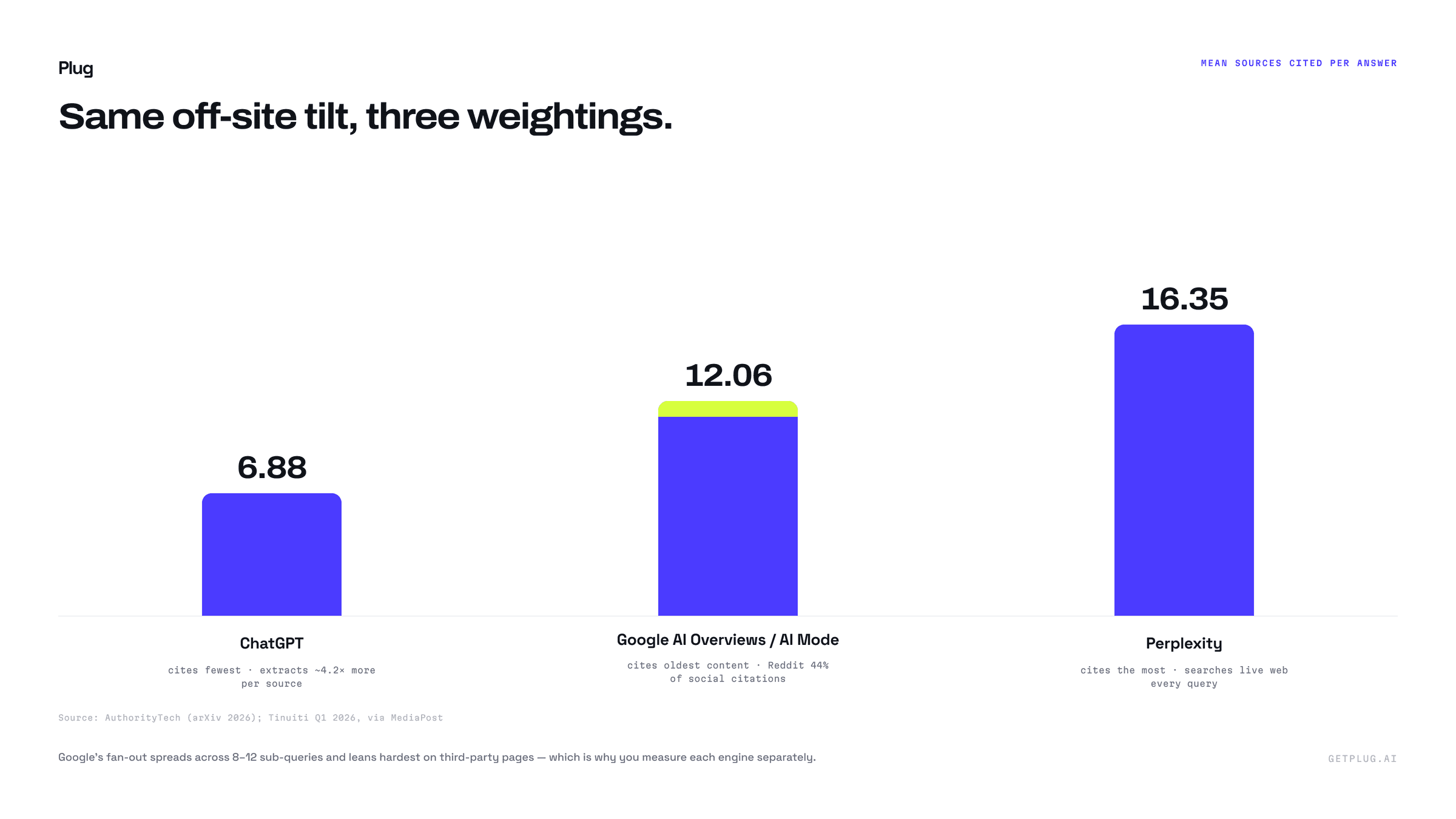
The gap between engines is wide. ChatGPT cites the fewest, a mean of 6.88 per answer, but extracts about 4.2 times more language from each, rewarding one deep quotable passage. Perplexity cites the most at 16.35 and searches the live web every query, though counter-intuitively it does not favour fresh content: the pages it cites average 1,166 days old. Google sits between them at 12.06 and cites the oldest content of the three, averaging 1,432 days, almost exactly matching organic search.
Same off-site tilt, three different weightings, which is exactly why you measure each engine separately. The companion pieces on how ChatGPT chooses which sources to cite and how Perplexity decides what to cite cover those mechanics side by side.
Why your AEO dashboard can't see Google's real citations
Your AEO dashboard watches your domain, while AI Overviews and AI Mode are out citing everyone else's: the Reddit threads, YouTube transcripts and review pages that make up the off-site majority. An on-site tool can tell you whether Google indexed your page. It cannot tell you that an AI Overview answered a buyer's question by quoting a three-year-old Reddit comment about you. And three years old is not an edge case here, given Google's cited pages average 1,432 days.
This is the blind spot the whole off-site category exists to close. If Reddit is 44% of AI Overviews' social citations, and 62% of cited pages sit outside Google's top 10, a share that grew from 24% in eight months, then the pages deciding your brand's AI answer are mostly pages you neither own nor track. That is why your AEO tool shows nothing for off-site work. It was built to audit your site, and the citations moved off it.
To measure what Google actually quotes, run your buyer queries in AI Overviews and AI Mode on a schedule, log every cited URL, separate your domain from the third-party pages doing the real work, and track that mix over time the way AI Share of Voice, off-site lays out.
Where this leaves you
Google's AI answers don't cite the best-marketed page. They fan your question into parallel sub-queries and cite whichever passages answer them cleanly, and most of those passages live off your domain. Reddit alone is 44% of AI Overviews' social citations, and 62% of cited pages never appear in the top 10, up from 24% eight months earlier.
So the winning move has two halves: write passages built to survive the fan-out, answer first, one sub-question each, dense with facts and named entities. Then make sure that writing exists where Google looks, on the forums, videos and editorial pages that dominate its citations. Then measure it per engine, over time, off-site.