ChatGPT chooses sources with a retrieval-augmented pipeline: it searches the live web, ranks results on relevance, fact density, entity clarity, structure and authority, then cites only the handful that directly support each claim. It shows around seven sources per answer, cuts roughly 85% of what it retrieves, and extracts about 4.2 times more text from each source than the engines that cite more widely. One deep, quotable passage beats ten shallow mentions.
If you want to be cited by ChatGPT, you first have to understand that ChatGPT is not remembering you, it is retrieving you. When someone asks a question that needs current or specific information, ChatGPT browses, pulls a set of candidate pages, ranks them, and quotes the survivors. Most candidates lose. This post walks through how that selection works, which signals decide it, and what it means for the off-site content, the Reddit threads, reviews and third-party posts, that ChatGPT quotes far more often than your own marketing pages.
How ChatGPT actually selects sources: retrieval, not memory
ChatGPT selects sources through retrieval-augmented generation: it runs a live web search, retrieves candidate documents, ranks them on relevance and quality signals, extracts clean facts, and cites the pages that directly back each claim. The model isn't reciting what it knows, it is quoting documents it fetched seconds ago. That single fact is why fresh, well-structured off-site content can get cited even if the model never saw it in training.
The pipeline is a funnel, and it is a steep one. AirOps research on ChatGPT's browse mode found that 85% of the pages ChatGPT retrieves never appear in the final answer. A page can pass retrieval and still get cut before the response is composed. What survives is narrow: across 602 prompts and 21,143 citations, ChatGPT cited a mean of 6.88 sources per answer while extracting about 4.2 times more language from each one. In plain terms, ChatGPT reads deep, not wide. It wants a few strong sources it can quote at length, not a long list of thin ones, which is the opposite of classic SEO where breadth of mentions helped. For the full off-site source mix, where AI actually gets its answers breaks it down engine by engine.
What signals ChatGPT ranks sources on
ChatGPT ranks candidate pages on five signals: topical relevance to the query, information density, entity clarity, structural clarity, and authority. Pages that answer the question directly, in a clean factual block, rank highest, and ranked pages become cited pages when they support a specific claim.
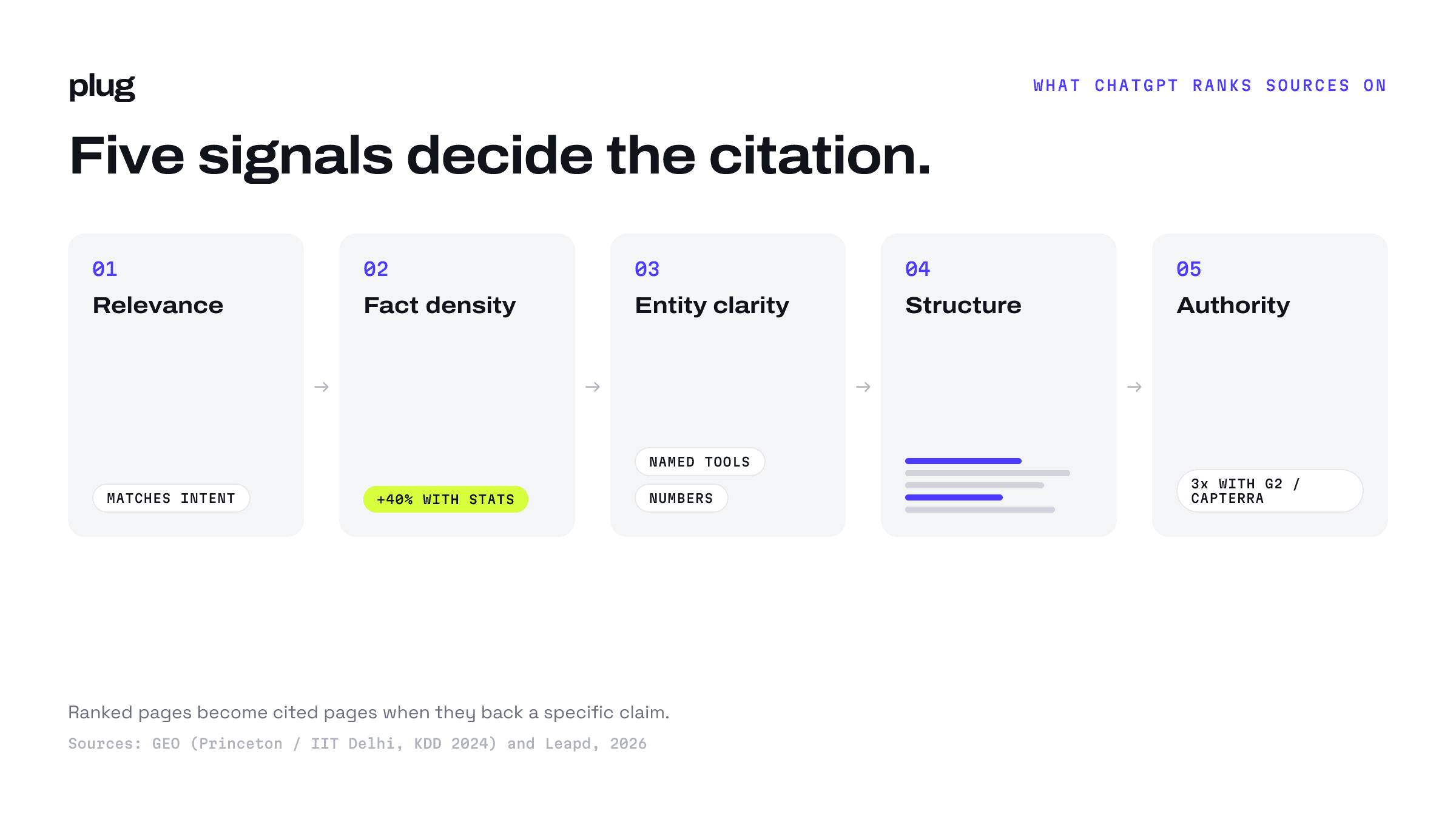
Two of those are measurable and worth front-loading. On density, the GEO: Generative Engine Optimization paper from Princeton and IIT Delhi, presented at KDD 2024, found that adding quotations, statistics and explicit sourcing lifted a page's visibility in generative answers by up to 40% across 10,000 queries, while keyword stuffing did not help. On authority, third-party presence is the lever most people miss: domains with active profiles on platforms like G2 or Capterra show roughly three times higher citation probability. That is exactly why third-party pages, a well-upvoted Reddit thread, a detailed G2 review, an editorial roundup, so often out-cite your own site. They combine independent validation with the dense, specific language ChatGPT is built to lift.
Why ChatGPT prefers third-party sources over your own site
ChatGPT prefers third-party sources because retrieval-based models treat independent pages as validation, not marketing. A Reddit recommendation, a review-site listing or a journalist's roundup reads as what other people concluded about this product, which carries more weight than your own landing page saying the same thing. So even a strong owned page often loses the citation to a page you don't control.
The scale of the off-site tilt is easy to underestimate. Only 38% of the pages cited in Google's AI Overviews also rank in its top 10, down from 76% eight months earlier, so the other 62% come from outside the search results you are used to watching. And the single most-cited domain across engines is Reddit, which appears in 12.6% of SearchGPT answers on Semrush's October 2025 tracking, the highest rate of any major engine. For ChatGPT specifically, reference sources weigh heavily too, but the pattern holds: the pages ChatGPT quotes about you are mostly pages you didn't write. That is the gap on-site AEO dashboards can't see, and it is why your AEO tool shows nothing for off-site work. The half that gets cited most is the half it never looks at.
How to get cited by ChatGPT: make your passage the easy one to quote
To get cited by ChatGPT, write the passage it can lift without editing: open with a short direct answer, pack the section with specific facts and numbers, name the entities explicitly, and keep each section self-contained. Because ChatGPT extracts deeply from few sources, a single dense, quotable block outperforms a page full of vague claims. Then make sure that block lives where ChatGPT looks, which is often off-site rather than on your domain.
Put the answer near the top, and mean it literally. Around 44% of AI citations come from the first 30% of a page, so a direct answer sitting under the heading is doing most of the work. Give the model a passage that already reads like the answer and you cut its work to near zero. Beyond that: lead with the conclusion, support it with at least one hard number, name specific tools and platforms instead of "AI tools", and structure with clean headings and FAQ blocks so a section stands on its own when lifted. The same discipline works inside a Reddit comment or a review, which is why getting cited on Reddit by ChatGPT uses the identical format rules, just off your own site.
How ChatGPT's choices differ from Perplexity and AI Overviews
ChatGPT differs from the other engines mainly in depth against breadth. In the same 602-prompt study, ChatGPT cited a mean of 6.88 sources per answer, Google AI Overviews 12.06, and Perplexity 16.35. Perplexity casts the widest net; ChatGPT is the most selective and extracts the most from each page it keeps. Same off-site tilt, different weighting.
The practical takeaway is that AI visibility is not one number. Engines lean on the same source very differently, and the gaps are large: on Semrush's October 2025 tracking, Reddit appears in 12.6% of SearchGPT answers against 3.5% of Perplexity's, so a Reddit-heavy push moves your ChatGPT share faster than your Perplexity one. A page that wins in ChatGPT's deep-extraction model, one long authoritative quotable passage, is not automatically the page that wins where breadth counts. How Perplexity decides what to cite covers the other side of that trade, where the widest net changes the job completely, and how Google AI Overviews and AI Mode pick sources covers the third case, where the unit being cited is a passage rather than a page. The common thread is that you measure each engine separately, and you measure it off-site.
How to tell whether ChatGPT is actually citing you
You tell whether ChatGPT is citing you by running your real buyer queries in ChatGPT on a schedule and logging every source URL it shows, then checking how many are yours, how many are third-party pages about you, and how that changes over time. Because ChatGPT retrieves live and its answers shift day to day, a one-time check tells you nothing. Only repeated measurement reveals the trend.
Set up a simple loop: freeze a list of 10 to 30 buyer questions, run them in ChatGPT and your other target engines on a regular cadence, and record each cited URL so you can separate your own domain from the Reddit threads, reviews and roundups doing the real citation work. Then track your off-site AI Share of Voice, the share of those cited sources that are about you, the way AI Share of Voice, off-site lays out, with benchmarks for what good looks like. Watch for drops too: a page ChatGPT cites this month can fall out next month if a denser or more authoritative source appears.
Where this leaves you
ChatGPT doesn't cite the best-marketed page. It cites the most retrievable, most quotable, most independently validated one. It retrieves widely, cuts about 85% of what it finds, and quotes a deep handful, usually third-party pages, usually off your own domain. So the winning move has two halves: write passages built to be lifted, answer first, dense with facts, named entities, self-contained, and put that writing where ChatGPT actually looks, on the reviews, forums and editorial pages that make up most of what it quotes. Then measure it per engine, over time, off-site.