Social listening tracks what people say about a brand across social platforms and forums, scored by volume, reach, and sentiment over a short window. AI citation tracking records which specific third-party pages AI engines quote when answering buyer questions, scored by retrieval. Same raw internet, different sampling: one counts humans, the other counts machine reuse.
These two tools get confused constantly, usually in the meeting where someone says "we already have Brandwatch, doesn't that cover AI?" It doesn't, and the reason is more interesting than a feature gap. The two categories disagree because they sample different populations over different time windows. This post lays out the definitions, the four concrete places they diverge, and when each one is the right instrument. Every figure below comes from a public study, cited inline.
What social listening measures
Social listening ingests posts, comments, and mentions across platforms, meaning X, Reddit, LinkedIn, TikTok, YouTube, news and review sites, matches them against brand keywords, and reports volume, reach, sentiment, and share of conversation. The unit of measurement is the mention. The audience is human. The default reporting window is days or weeks.
It is a mature, well-built category and it answers real questions: is this campaign landing, is a complaint spreading, who are the loudest voices in our niche, is sentiment moving after the pricing change. Nothing below is an argument that social listening is broken. It measures human attention accurately. It just wasn't designed to tell you what a retrieval system does with the same text six months later, and it doesn't.
What AI citation tracking measures
AI citation tracking runs a fixed set of buyer questions against AI engines, meaning ChatGPT, Perplexity, Google AI Overviews and AI Mode, Copilot, and logs which URLs each engine actually cites, what claim it lifted, and who owns the page. The unit is the citation. The audience is a retrieval pipeline. The window is however long a page stays quotable, which turns out to be years.
Off-site citation tracking narrows that further to pages the brand doesn't own: the Reddit thread, the G2 listing, the YouTube review, the roundup post on someone else's blog. That's the half most dashboards can't see, and the full definition is in what off-site GEO is and why your AEO tool can't see it. It matters because only 38% of the pages cited in Google's AI Overviews also rank in its top 10, down from 76% eight months earlier (Ahrefs, via Search Engine Journal). The other 62% sit outside the report most teams already run.
The four places they diverge
They diverge on unit, window, population, and outcome. Any one of these would make the tools non-substitutable. Together they explain why a brand can have a great listening quarter and a terrible AI quarter, and never connect the two.
1. Unit: mention vs citation. A mention is a human writing your name. A citation is an engine quoting a page and linking it. They overlap but are not nested: an engine can cite a page that never mentions your brand in a way listening would catch, and thousands of mentions can produce zero citations. The vocabulary matters enough that we gave it its own post: citation vs mention vs brand mention.
2. Window: weeks vs years. This is the biggest one, and the next section is about it.
3. Population: platforms vs sources. Listening tools sample the platforms they have API access to, weighted toward high-velocity social. Engines sample the whole indexed web, weighted toward whatever their retrieval layer trusts. Reddit is referenced in roughly 40% of AI answers (Semrush, 150,000 citations, via MaxAEO), and review platforms punch far above their conversational volume: domains with active G2 or Capterra profiles show roughly 3x higher citation probability (Leapd). A G2 listing generates almost no social chatter and considerable citation weight.
4. Outcome: sentiment vs presence. Listening tells you how people feel. Citation tracking tells you whether you're in the answer at all. A buyer asking ChatGPT "best tools for X" never sees sentiment scores: they see a shortlist, and you're on it or you're not.
The window mismatch: why the two dashboards disagree
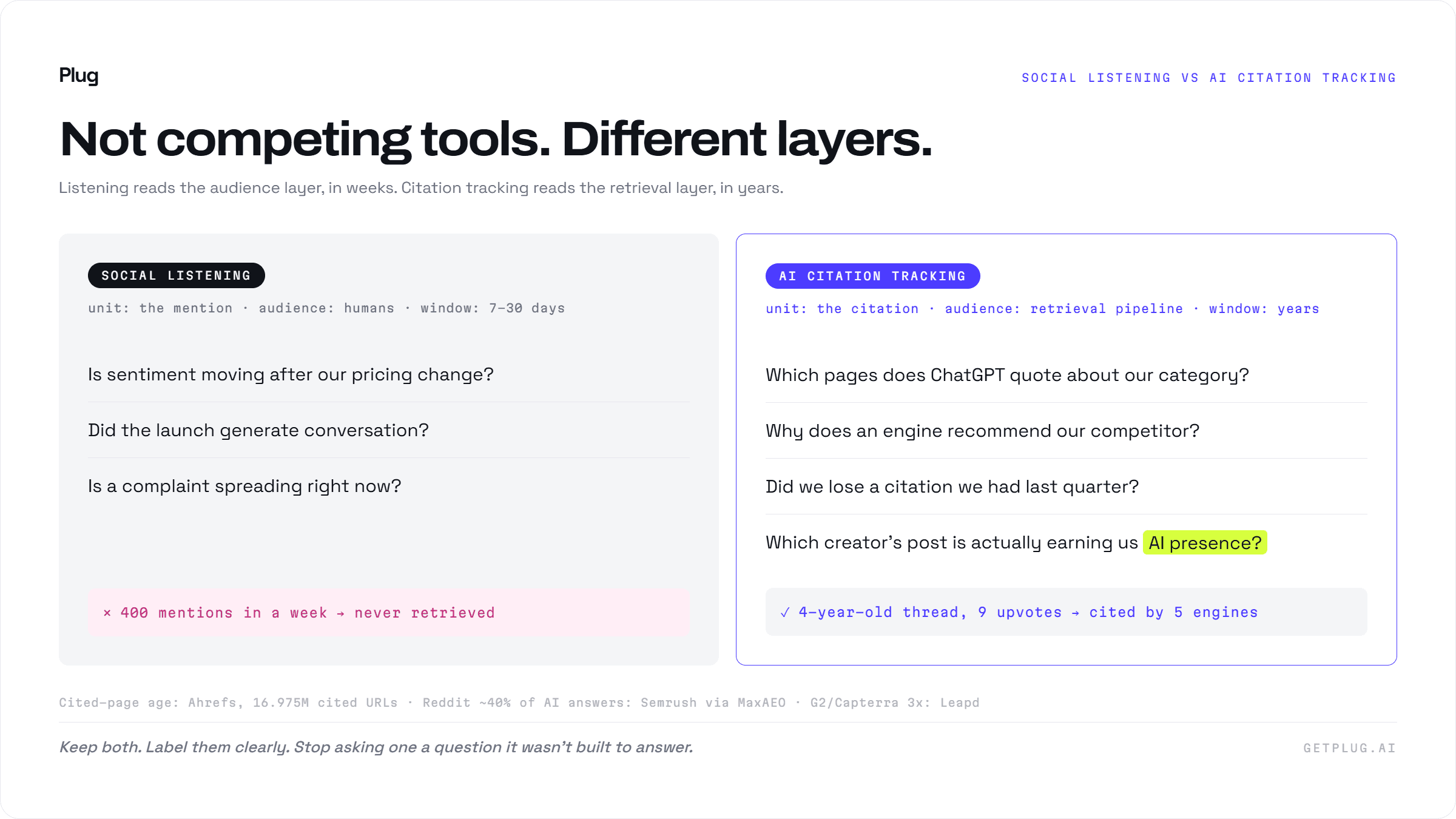
Because they sample different time periods of the same internet. A social listening dashboard defaults to the last 7 or 30 days, since human attention decays fast and stale mentions aren't actionable. AI engines reach much further back: pages cited by Perplexity average 1,166 days old, with a 1,064-day mean across AI assistants (Ahrefs, 16.975M cited URLs). That is roughly three years, against a listening window of weeks. One thing to get right before you repeat it, because it is often repeated backwards: Ahrefs found AI actually cites fresher pages than classic organic results, which average 1,432 days. Fresher than search, and still years older than anything a listening report surfaces.
Put those side by side and the disagreement stops being mysterious. Your listening tool is reporting on a window the engines have largely moved past, and the engines are quoting pages your listening tool archived before anyone on the current team was hired. Two accurate instruments, two non-overlapping samples, one confused meeting.
The practical consequence is that a spike and a citation are almost unrelated events. A launch post that generates 400 mentions in a week may never be retrieved, because it lands in the noisiest, least-established period of its life. Meanwhile a thin, four-year-old comparison thread with nine upvotes is the page five engines quote when someone asks whether you're worth buying. Volume is not durability. That inversion is the single most useful thing to take from this post, and it's why "we're getting talked about a lot" is not evidence of AI visibility.
Do you need both?
Usually yes, and they answer different questions, so budget them separately rather than making one justify the other. Buy listening to manage reputation and campaigns in real time. Buy citation tracking to manage which sources feed the answers buyers actually receive.
A workable split:
| Question | Right tool |
|---|---|
| Is sentiment moving after our pricing change? | Social listening |
| Did the launch generate conversation? | Social listening |
| Which pages does ChatGPT quote when asked about our category? | AI citation tracking |
| Why does an engine recommend our competitor? | AI citation tracking |
| Is a complaint spreading right now? | Social listening |
| Did we lose a citation we had last quarter? | AI citation tracking |
| Which creator's post is actually earning us AI presence? | AI citation tracking |
If the budget forces a choice, decide by buyer behaviour. If your category's buyers research on social and in communities before shortlisting, listening earns its keep. If they open ChatGPT or Perplexity and ask for a shortlist directly, citation tracking is measuring the moment that decides the deal, and listening is measuring the weather around it.
What citation tracking is not
It is not a competitor comparison tool, not a rank tracker, and not a traffic channel. Worth stating plainly, because each mistaken expectation produces a bad quarter.
Not rank tracking. Rankings and citations have come apart: the top-10 overlap in AI Overviews fell from 76% to 38% in eight months (Ahrefs, via Search Engine Journal). Page-one position no longer predicts being quoted, which is the whole reason the category exists.
Not a traffic report. A citation often produces no click at all. Report it as presence in the answer, not as sessions, and never forecast traffic from citation counts.
Not comparable across engines without splitting them. ChatGPT cites a mean of 6.88 sources per answer, Google AI Overviews 12.06, and Perplexity 16.35 (arXiv 2026, via AuthorityTech). Three citations mean very different things on each. Blend the engines and you've destroyed the number before you've reported it. The measurement conventions are in AI Share of Voice, off-site, and the source landscape itself is mapped in where AI actually gets its answers.
Where this leaves you
Social listening and AI citation tracking are not competing products; they're instruments pointed at different layers of the same internet. Listening reads the audience layer, in weeks. Citation tracking reads the retrieval layer, in years. Keep both, label them clearly, and stop asking the listening dashboard a question it was never built to answer: the mentions it counts and the pages engines quote are, on current evidence, mostly different pages from mostly different years.